Wednesday, January 15, 2014

Beer Chemistry Presentation

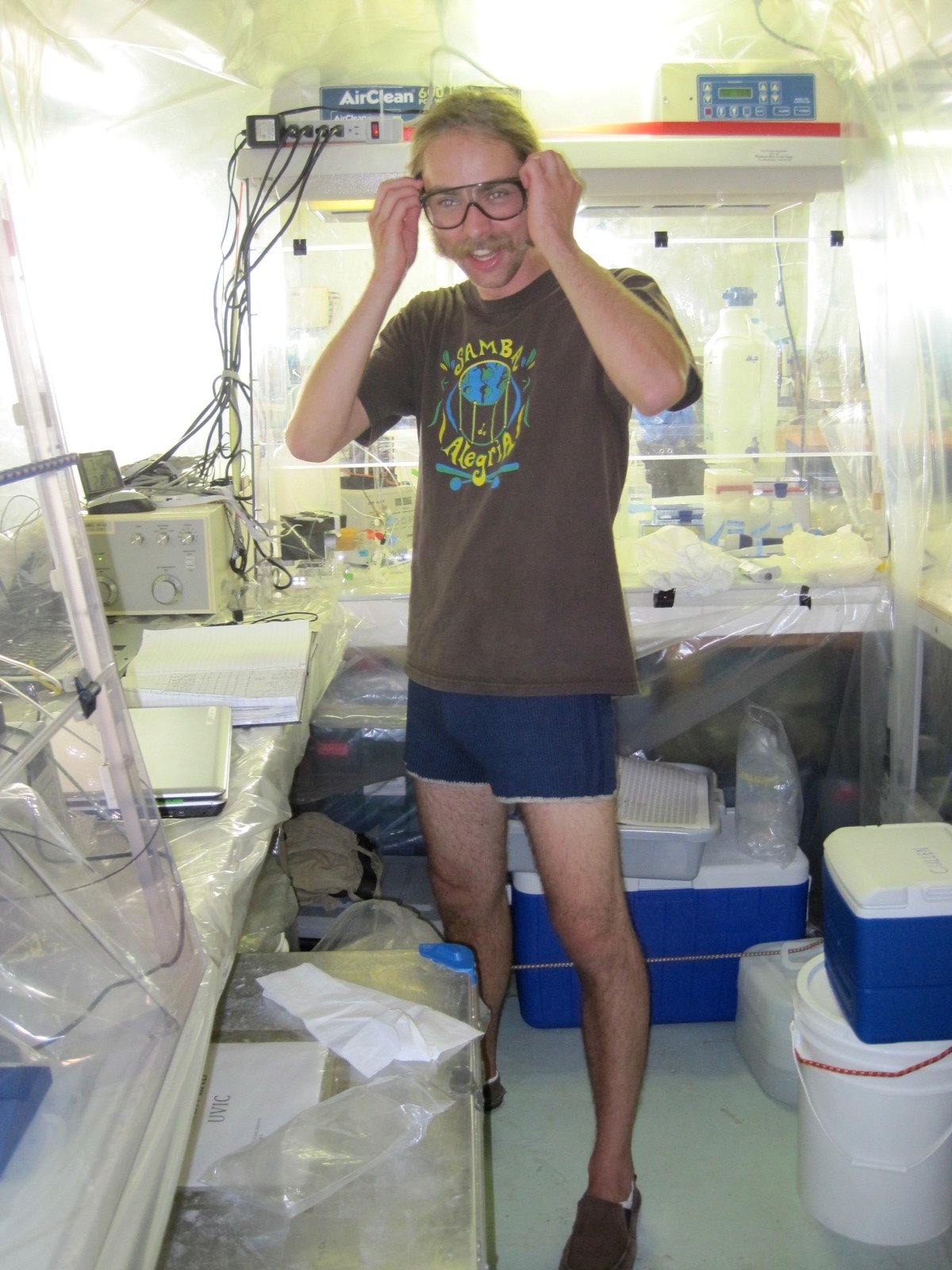
Me nerding out on chemistry (unfortunatelly not beer chemistry here)
I gave a presentation today about the chemistry of beer at the Max Planck Institute for Chemistry in Mainz Germany (where I am currently doing a bit of work for my PhD). I've done this sort of thing a couple times before for the School of Earth and Ocean Sciences at the University of Victoria, and I'm taking the opportunity of presenting for an institute of chemists to nerd out a bit more on the chemistry (see sidebar picture). It seems to have gone pretty well, and I thought I'd share some of the highlights from my talk. A lot of this might not be terribly important for the practical brewer, but if you're interested in the science of brewing I think this stuff is kind of cool.

Water Chemistry: A lot of this information can be found in the Water book by Palmer and Kaminski that was recently published by Brewers Publications. This book does a good job of compiling the information out there on brewing water while correcting some commonly-held misconceptions. The book also does a good job of remaining approachable/understandable while getting into brewing water chemistry. I talked a bit about alkalinity and it's relation to brewing. I thought the residual alkalinity figure on p. 69 compiled a lot of the important concepts into one simple figure (I don't want to infringe on any copyrights so I won't reproduce it here). For those without the book, I'd recommend it, especially if you are brewing with grain and are interested in really taking control of your brewing process.

Hop Antibacterial properties: We all know that hops carry antimicrobial properties, and the specific mechanisms aren't necessarily important for the practical brewer. Nevertheless, I think the mechanistic antibacterial activity is pretty interesting. Hop acids (iso-alpha primarily in modern beer, but beta-acids are also antimicrobial) have antimicrobial properties against gram positive bacteria (this includes bacteria such as Pediococcus and Lactobacillus but not Acetobacter). Iso-alpha acids are ionophores, meaning that they disrupt the chemical gradients (specifically the proton gradient) across bacterial cell membranes. The acids leak into the cell, lose a hydrogen ion and then migrate out of the bacteria cell across the cell membrane. I think the really funky stuff comes in with bacteria that are resistant to iso-alpha acids. Resistance appears to be specific to hop acids and it is stably encoded on chromosomal DNA (in contrast to some of the drug-resistant characteristics of other bacteria such as some human pathogens). What this means to the non-microbiologist is that the bacteria that are able to resist the antimicrobial characteristics of hop acids can specifically recognize hop acids and remove them from the cells. Furthermore, the bacteria keep this genetic information to recognize these hop acids even if they haven't been exposed to hop acids for a long time. But fortunately for brewers it also means that this secret hop-resistant information which some bacteria have is not easily transferred to other bacteria. This 2003 paper by Sakamoto and Konings details all of this quite nicely. (I know sometimes journal access can be tricky for those not connected with a subscriber, but I imagine some of you out there might theoretically know someone with access. In addition, paper authors are often willing to share their papers with interested folks if you contact them.)

Hop composition comparison - Old and new German and North American hops:
I use the term old North American hops a bit loosely here I suppose. I wanted to compare landrace hops such as Tettnanger and Hallertaur Mittelfruh with newer products from German hop breeding such as Saphir. For the corollary with North American hops I chose Cascade compared to Simcoe and Citra. While Cascade is still quite young, it shows the difference between old and new hop breeding trends (Cohumulone percentage and oil levels). While some modern research has counteracted the commonly held belief that high cohumulone hops are harshly bitter, modern hop breeding has still kept cohumulone levels in mind and newer hop varieties have much lower cohumulone percentages. Here is a table detailing some different hop varieties in their acid and oil composition. Note that the German hops show much higher levels of the sesquiterpene oils (humulene and b-caryophyllene) which are perceived to be spicy while the North American hops show much higher myrcene levels.

Characteristics of German and North American Hop varieties (usahops.org, deutscher-hopfen.de, Yakima Chief)

Flocculation: The Journal of the Institute of Brewing recently celebrated it's 125th Anniversary and published some nice reviews about brewing topics. One of these reviews dealt with flocculation. It detailed 3 main yeast flocculation phenotypes (behaviors). Two of these three (and the two which are better understood) rely on yeast proteins binding sugar residues on the cell walls of other neighboring yeast cells. Depending on which sugars can be bound, this influences the onset of flocculation. For example, if maltose if one of the sugars that the flocculation proteins can bind, flocculation will not occur until all the maltose in the wort is used up and the yeast can actually find the sugars attached to adjacent yeast cells. But if flocculation only depends on a sugar that isn't very prevalent in wort such as mannose, then flocculation may occur earlier while there are still fermentable sugars in the wort. I used to think about flocculation only about the yeast settling out of suspension, but technically speaking flocculation in the clumping together of yeast cells. These clumps, or flocs, can then rise to the surface when they are carried up by CO2 released during fermentation and show up in the krausen we are used to from ale fermentations.

Alright, I think this is enough nerdy chemistry from one post. If it was too much, take another look at the picture of me at the start and maybe you'll feel better. If it wasn't enough for you let me know and we nerd out a bit more.

Saturday, January 4, 2014

Body in Brett/Sour Beers – Starting thoughts


Sorry for the lag in posts over the past couple of weeks. This one was close, but not quite ready before I took off for some Christmas time travels.

This is something I’ve been thinking about for a bit and have recently begun to look into further. I suspect it will be a reoccurring topic with the blog. I started thinking about this after trying a couple of 100% Brettanomyces (commonly shortened to brett) beers that I thought were flabby and pretty awful in the mouthfeel department. Something wasn’t quite right. That contrasts with highly-attenuated saisons that I regularly have finish at/around 1.000 but that don't seem too thin and this got me thinking about what was up with these brett beers. I soon discovered that this was potentially due to glycerol production by the yeast, and I suspect many out there have come across this info as well. So I want to get in to thinking about body/mouthfeel in sour beers/brett beer/general beers with very high levels of attenuation. I am treating this post sort of as a jumping board for organizing thoughts and going further into this. And it can also serve as a quick primer if you are wondering what glycerol is, how it gets into your beer and why that matters.


Glycerol levels in different beer styles

Glycerol is a compound produced by yeast during fermentation. For the microbiology minded out there, glycerol production helps yeast correct an NAD+/NADH imbalance caused by fermentation by acting to restore the depleted cellular NAD+ levels. It is the act of producing the glycerol, and not having glycerol around in the environment, which corrects the imbalance. For the non-microbiology minded, producing glycerol helps yeast cope with the stresses of living in an alcoholic environment. For the beer (or wine) drinker, this glycerol adds mouthfeel to the beer.
It turns out that brett doesn’t produce glycerol (potentially in certain strains/in some cases brett can produce glycerol but in MUCH lower levels than normal Saccharomyces yeast). The table at right shows average glycerol levels in acid beer (6 Belgian and 1 German), lagers (8 Dutch, 2 Danish and 1 German) and ales (2 Belgian, 1 Dutch and 1 German). The error bars for the darker columns represent standard deviation and the error bars represent the spread of the data (top of error bar = max value, bottom or error bar = min value) in the paler columns. As you can see, ales are generally showing slightly higher levels, but also with much larger variability within this specific sample set. Meanwhile acid (sour) beers generally show lower levels, which makes sense given the importance of Brettanomyces yeasts in the fermentations of some sour beers. What was surprising to me about this data is that the glycerol production is in the range of grams/l meaning beer is 0.1-0.3% glycerol by weight. That's only about an order of magnitude less than the amount of alcohol produced! So glycerol is a reasonably major byproduct of fermentation.

Constructing recipes with mouthfeel in mind: When talking about body in beer in this podcast (this episode of Brew Strong ~13 minutes in), Charlie Bamforth (brewing professor at UC Davis) said that it takes a considerable amount of dextrins to achieve much of a mouthfeel impact. And he mentions he has heard others suggest that glycerol makes a bigger contributor to mouthfeel. So mashing at higher temperatures for more body may not be the most direct/best way to get a beer with a more full mouthfeel. This is especially true when dealing with brett.

Brettanomyces yeast strains have extracellular and intracellular a-glucosidase enzymes. This means that brett is able to break down and ferment the dextrins that normal brewing yeast can’t and is a reason why brett can achieve such high attenuation levels. So mashing high in a brett beer doesn’t necessarily mean you end up with more dextrins in the final beer. But it certainly could mean that you are in for a LONG fermentation as the brett slowly chews away at all those dextrins you carefully created in the mash. So here you basically have a lose-lose: the dextrins you made may not survive and you have and an unnecessarily extended fermentation.

Chad Yakobson of Crooked Stave, one of the foremost experts in brett fermentation, suggests another route: building body by using grains with higher protein levels. These will remain through to the finished beer, unlike dextrins from a high mash temperature, and can fill the void left by using low glycerol producing yeasts like brett. Chad uses oats and spelt (5-8% of the total grist) and suggests other grains such as rye.

So this is where I'm at. I'm starting to read the scientific literature about glycerol production by various yeasts. In addition I'm looking into the enzymatic capabilities of different brett strains to try to determine what they can and cannot break down, and therefore what sorts of things would remain in the beer. Look for more posts about this sort of thing and going in depth a bit more in the future

Closing Acknowledgement: Although I mentioned it above, I should note again that a lot of the information here (and a bunch in posts to come) comes from Chad Yakobson. Specifically his presentation at the 2011 NHC and this podcast.

Tuesday, December 10, 2013

Cantillon Public Brew Day Part 2

Aging lambic from the P brewing season.
"There are no secrets to lambic brewing..."

This follow up to my first post of the Cantillon brew day will be mostly a list of things that came up throughout the day from conversations with Jean, trying different Cantillon beers, and anything else that came up on brewday but didn't fit well into the description of Cantillon's brewing process. And some more pictures. It's a lot less brewing information but I think it is some interesting stuff for approaching new ideas with non-standard lambics and fruit lambics.

It seems that Jean must be constantly thinking of new experiments/blends/lambic treatments because he mentioned at least 5 ideas to me that he's working on or planning. Here are some of those experiments/ideas. Hopefully this gives some ideas to lambic homebrewers for new things to do with a lambic base. I know they definitely got me thinking.


Spiderwebs on the Cantillon grain mill belt-drive.
Half en half - An old Brussels tradition, and it is exactly as it sounds. A 50/50 blend of two beers. The idea of blending beers at serving time is not new to me but I wouldn't say I've done much beer blending of any form aside from a bit of
blending similar beers at bottling to smooth out rougher characteristics and gain complexity. And I certainly would not have thought of blending lambic in the glass. But I have to say I will certainly do it in the future. Jean produced what he called his favorite blend for a fellow homebrewer/lambic enthusiast I met at the brew day named Ben to keep Ben refreshed while he shoveled out the mash tun. The blend was equal parts Fou Foune and Rose de Gambrinus. Man was it good. So good that I later made my own with Fou Foune and a pour from a bottle of Lou Pepe Framboise. The soft floral character of the apricot and the more acidic bright fruityness of the raspberry work really well together, and the balance of the two was great. I definitely think the blend was better than either of the component beers on their own. And if/when I start adding fruit to my lambic based beers, I definitely intend to blend different fruit treatments at bottling so I can have a pseudo half en half without opening two bottles at once.

The main boil kettle (left) and secondary kettle (right) with belt-driven mixers
Mash rest after adding back the pulled runnings.
Riesling lambic (barrel sample) - A dry riesling has a lot in common with a sour beer such as lambic, both being light bodied, fruity and acidic. In terms of adding a new depth to lambic, I'm not sure what riesling juice might do (I haven't tried any of the other sours out there made with riesling juice) but I can say at this point the Cantillon riesling lambic tastes great. Judging from the posting date on Cantillon's facebook page, this blend was probably made around 2 weeks before I tried it. At this point is has much of the riesling fruityness and the sweetness of partially fermented riesling (see side note below). There is a great mix of acidity from both the riesling juice and the young lambic. A touch of the 'petrol' character that rieslings sometimes have, but it was mild and definitely not off-putting.

Side note - The part of Germany where I'm currently living, Rhineland Palatinate, is the country's leading region for wine production. During harvest season there is a popular partially fermented wine called federweisser, which has a slight carbonation due to the active fermentation. You can find it in varying degrees of sweetness, from something that is hard to differentiate from grape juice to almost finished wine. I didn't know what it was the first time I saw people drinking it at little kiosks which are all over town, and it looked kind of creepy. It is hazy from the still active yeast and is a pale green color. Bottles have only a loose cover (no seal) because they are fermenting when you buy them. Anyway, I think it is reasonably pleasant and shares some major common ground with the current state of the Cantillon riesling lambic experiment.

The signs of a past active fermentation.
50N 4E - If you didn't know about this beer before, it is gueuze made form lambics aged in cognac barrels. I think this is a great combination of spirit barrels and beer. The cognac is smooth enough to blend with the lambic flavors. It adds a nice perception of sweetness softens the lambic acidity while leaving plenty of room for the lambic character to come through. Jean said the current blend, bottled in 2012, is 25% cognac barrel aged lambic and 75% normal lambic, but for the next bottling of it he plans to flip those percentages and use 75% cognac barrel aged lambic. I'm interested to see how that turns out, because at the current 25% cognac barrel aged level I think the spirit quality comes through prominantly and softens the lambic very nicely while still letting the lambic part be present. So for the homebrewer, if you were thinking of making a richer lambic with some spirit character (or if you weren't before but are now), I think cognac is a really good choice.


Amphora update - In January 2012 Cantillon started experimenting with aging lambic in amphoras (and another link). The first lambic batch started in the amphoras and was aged 14 months. Jean said that he felt this batch spent too long in the amphora and became too rough and minerally. He is planning a second batch to be aged in the amphoras, but this time he plans to take 1 year old lambic from barrels and transfer it into the amphoras with a  bit of fresh lambic wort to kick start an active fermentation to protect the wort from oxygen in the transfer and amphora environment. Then the lambic will age in the amphoras for something on the order of 5-7 months. This seems to be a good compromise of getting character from longer aging without the roughness Jean was getting from extended amphora aging.

Other miscellaneous info
The boil kettles
Blending/bottling - Jean said Cantillon doesn't bottle if the lambic temperature is above 20C and that bottling usually stops around May. I know I've seen bottling in action during the summer and I've seen dates on bottles of Cantillon fruit lambics to confirm this, so I suspect that I didn't catch that he was referring only to gueuze blending/bottling. This seems to make sense. For the fruit lambics, the time he can add the fruit is dictated by harvest and bottling time is determined by when the lambic needs to be removed from the fruit, so bottling may have to take place over summer. But for gueuze the timing isn't pre-determined by harvest and maceration times, and it makes sense to save bottling for a time when the lambic is done with the microbial, and especially bacterial activity peak seen in summer (as this paper shows). I hadn't really thought of this, but it makes complete sense for the quality of the gueuze. And the overlap with brewing season provides freshly emptied barrels for new lambic to go into, though it probably also makes for a very busy winter. It seems other brewers/blenders are doing this as well, as Tilquin recently posted about the start of their blending season.

The Cantillon hop filter, complete with the magic sock.
I'll close this off with a couple more pictures of the coolship in action and an explanation of the quote at the start. It is what Jean said to me as I was thanked him for the day and all the time he spent talking to me. He there are no secrets in lambic, and that I've seen everything he does. Then he thought for a second and said,

"There is one secret to lambic... Love. Love and passion."


And from watching him brew, you can feel the serious passion he has for the making quality lambic. I enjoyed Cantillon lambics before and respect what they do and what they have done for lambic. But after seeing the process I have a whole new respect for everything that goes on there. It takes a lot to open up your brewery to hundreds of people so they can watch you brew for a day. And to brew the same base wort (nearly) every brew session while still coming up with new great ideas for the final product definitely takes passion.
More pictures of the coolship in action.


So thanks to Jean, and to all you for reading this (and the previous) post about the Cantillon brewday.

-Dave


Sunday, December 1, 2013

Cantillon Public Brew Day (9 November 2013) Part 1 of 2


Preface: Cantillon is one the few remaining (and probably the most well-known) traditional brewers of the spontaneously fermented lambic beer. Lambic beer is native to the Senne river valley in the area of Belgium including and around Brussels. The brewery is owned and run by the Cantillon/Van Roy families, with the brewing traditions passed down to each new generation of brewers. Jean Van Roy is currently the brewer at Cantillon, though he is now beginning to teach his son to brew. Each March and November the brewery invites the public to observe one of their brew days. On any other normal day of the year (excepting Sundays) the brewery/tasting room is open for visitors to take a self-guided tour and try the beers. But on the public brewing days you get a rare chance to see one of the more traditional brewing methods in action. In this first and rather long post, I'll run through the Cantillon brew day that I observed. In part 2 (to come later) I'll add a bit of extra info on beers I tried while there, info on unreleased Cantillon projects still in fermentation and on ideas that Jean is developing, lasting impressions from the brew day and maybe some extra pictures.


Barrel cleaning in action at Cantillon
Brew Day: As I opened to door to the brewery just before 7:30 on a cold Brussels morning I was struck by a warm humid wave, sticky and with the tannin of oak and the citric acidity and funk of a lambic. As I stepped inside I saw this was coming from the barrel cleaning already well underway. Empty barrels which previously held lambic are blasted with hot water to rinse out the trub (yeast and other sediment which has settled out from the beer), filling the entrance way with steam and the smell of the lambic the barrels once held. After the inside of each barrels is thoroughly rinsed, the barrels are placed into what has fittingly been described as a medieval torture device by Vinnie from Russian river in his 2007 NHC talk: chains are placed into the barrel, which is still partially full of hot water, and the barrel is then spun around to more thoroughly clean the inside of the barrel. This barrel cleaning would continue throughout most of the day, and I continued into the brewery (through the barrel steam permeating most of the ground floor) to drop my bag, grab a breakfast croissant and see the brew in action. I knew I could stop back later to get my fill of lambic-scented steam pouring out of freshly emptied barrels.

Cantillon's belt-driven pump recirculating the mash.
The wood-lined cast iron mash tun, kettle 1 (behind) and kettle 2 (right).

Unfortunately I missed the first half hour or so of the brew (mashing started around 7:00) on account of the 5 am bus that I wanted to catch being a couple of minutes early. So I had to wait another hour for the next bus (I was staying a bit outside Brussels and transport into the city was limited at this time of day). I arrived part way through the mashing, and so my information on exact mash temperatures and rest times is a bit lacking. I was filled in by some fellow homebrewers and lambic beer enthusiasts on what I missed. The first mash step (48 C I was told) had been completed and now we were resting at 66 C. And the first pull of wort had been transferred into the holding vessel/smaller boil kettle, following turbid mashing procedures. Looking at my notes and comparing to other reports of Cantillon mash procedures, I seem to be missing a rather short  rest at ~58 C.

Quick break - If you are unfamiliar with a turbid mash, it is procedure for very efficiently (in the sense of extract but not time) extracting  fermentable sugars and starches from the grains used in brewing. It is significantly more complicated than a normal brewing mash and it preserves significantly more unconverted starch than modern mashing procedures. This starch is unfermentable to the Saccharomyces strains typical to brewing but the additional yeasts (such as Brettanomyces) and bacteria (mainly Pediococcus and some Lactobacillus) can access these starches.

There’s an interesting history to turbid mashing with influence from the methods of taxing brewers in Belgium used over time. In brief, turbid mashing involves pulling liquid portions of the mash to be heated in a separate vessel, stopping enzymatic activity and preserving unconverted starch from the grain. These removed portions of mash liquid are replaced by hot water to increase the temperature of the mash to the next rest temperature, which is selected based off of the desired enzymatic activity. If you’re looking for more information on turbid mashing methodogy and history, I’d recommend the book Wild Brews (a really solid resource for anyone interested in Belgian sour beers), articles from past issues Brew Your Own magazine and other bloggers such as the Mad Fermentationist and Funk Factory. Alright, back to the brew day.

Draining the mash.

Bags around the brewery suggested that Cantillon was using organic Dingemans pils malt for this batch, though I think I've seen previously Weyermann malt bags there as well. The grist was 800 kg barley malt and 400 kg unmalted wheat and had been milled the day before. Cantillon operates with a mash tun, a hot liquor tank, and two boil kettles. One kettle is larger and serves as the main boil kettle and the second is smaller and serves as the pulled mash liquor holding/heating tank as well as the supplementary boil kettle. After a 15 minute rest at 72 C, Jean started the vorlauf (draining and recirculating the mash liquor to get clear mash runnings) and transferred the early runnings to the main boil kettle.


Adding the pulled liquor from kettle 2 back to the mash tun.
The first mash runnings went into the main boil kettle. Unlike in typical mashes, these runnings didn't taste all that sweet. Perhaps this is because mash liquor is being removed to the second kettle and replaced by water. The first runnings were hazy and tasted very starchy and a bit like hay. The tannins and unconverted starch countered the sweetness and gave much more of a dry taste than I expected. With the first runnings drained, the mash liquor which had previously been moved to kettle 2 was added back to mash tun and left to rest with the grain for 15 minutes before also being drained into the main kettle. These runnings were more clear (perhaps from protein precipitation during heating) and were sweeter than the 1st runnings, tasting closer to standard mash runnings.

Spent grain in the Cantillon mash tun.
Sparging (rinsing the grain with water) was carried out with 88 C water. The mash runnings in the first (main) boil kettle reached a boil before the the kettle was full. At 11:30 the first kettle was full and the mash runnings were directed to kettle 2. At about 12:30 all of the mash running were collected. The remaining spent grain had even less flavor than spent grain from a typical brew. I expected it to not have much taste but I was surprised by how little was left in the grain after the mash. I didn't get the complete pre-boil volume but at 13:00 (when kettle 1 had been boiling for aver 1.5 hrs) there was about 6038L in the main boil kettle and 2545 L in the secondary kettle (the sight glasses on the kettles at Cantillon are in cm, with a spreadsheet to give volume from the height of wort).

Hops being added to the main boil kettle.
The boil at Cantillon lasts 3.5-4.5 hours, with roughly 25% of the pre-boil volume evaporation during the boil. The target final wort volume was around 7000 L. Both boil kettles are hopped with aged hops, typical of lambic production but not in more standard brewing. This brew used 2010 Tettnang whole hops, but bales of 2009 Saaz and 2011 Halltertau are also waiting in Cantillon's attic. Jean's son weighed out 15 kilos - as Jean said, he must learn to brew lambic. And as Jean jokingly suggested throughout the day, learning at this point mainly involved the generally less desirable but definitely necessary brewing tasks such as weighing out ingredients and cleaning. It was pretty cool to see the active training of the next generation potential Cantillon brewer, even if he did get stuck with all the not so exciting tasks at this stage. I'm not sure if the entirety of this 15 kilos was added to the first (and main) boil kettle or if it was split between the two. If it is the entire hopping amount, this is in a bit of disagreement with reports of around 5 grams of hops added per liter of wort (which would suggest 35 kilos for a 7000 L brew day). Perhaps I am off with the 7000 L final wort volume, but it seems to match the ~8600 L mid boil volume I saw. So maybe another amount of hops was weighed out at a different time for the second kettle and/or the hopping is not quite 5 g/L. I guess I'll have to go back with some more questions for next time. It's hard work, but someone has to do it.

The copper rings and propeller inside the boil kettle
An interesting feature of the boil kettles at Cantillon are large internal copper loops (I estimate the larger of these is on the order of 10"/25 cm in diameter) and a propeller for mixing. I'm not sure what these are for. One (the larger outer ring) seems to line up with the inlet/outlet for the kettle (outside pictured above) but I'm not sure about the inside ring, which connects to a point higher on the side of the kettle. This must be for steam heating, or something like this.


The first bit of hot wort reaches the coolship.
Wort cooling in Cantillon's coolship.
At 15:10 the boiling was done and wort was transferred to the coolship, ending the brew day. The coolship is a large shallow copper tray in the top floor of the brewery which holds the hot wort as the wort cools overnight. The coolship room has slats at the wall which are opened, allowing the evening air to enter and cool the wort. The weather in Brussels this weekend was reasonably cooperative, raining at night time but mostly not during the day. Overall though, Brussels had been very wet over the preceding weeks. To a lambic brewer, this could be influential/of concern for a couple reasons. First, higher humidity outside means less evaporation during cooling, which means a slightly lower strength wort at the start of fermentation. I'm not sure how significant an effect this has, but I've heard other lambic brewers discuss how this can influence their lambic. Additionally the native micro-organisms in the air can be stripped out, influencing the spontaneous inoculation. Fortunately for breweries such as Cantillon that have been active for some time, brewhouse-resident microbes play a dominant role in spontaneous fermentation (Cantillon has been active in its building for over 100 years, but resident populations of microbes are observed in much younger breweries). So it is likely that the native air-born population of yeast and bacteria play a much more minor role and the terroir of individual lambic breweries is more driven by the yeast and bacteria living on ceiling tiles, joists, walls and inside the barrels in which the wort ferments. This brewhouse population may have arrived over years from the surrounding environment, among other sources, but now it is established within the brewery. This brewhouse-resident microbial community inoculates the wort as it cools. Consequently, there is a belief that lambic brewers hold (and rightfully so) that building renovations and/or changing location will alter the character of the beer. As I mentioned above, this is the final step (excepting cleaning) for the brewday and the wort will sit in this coolship overnight before being transferred to barrels for fermentation.
The coolship, with open wall slats allowing the evening air of Brussels in to cool the wort.

Thanks for reading and hopefully you learned something about lambic and/or Cantillon's brew process. Look for part 2 (info on beers I tried while there, unreleased Cantillon projects still in fermentation and ideas that Jean is developing, and lasting impressions from the brewday and more pictures) in the coming week.

Postscript: I've tried to write this to a more general audience and define some brewing terms that would be familiar to many brewers but not necessarily everyone else. And I tried to strike a balance between people well versed in lambic brewing and those that did not previously know of the style.

I talk about Cantillon and other lambic brewers and blenders a bit more in this 2016 post about visiting lambic  producers.