Showing posts with label Grisette. Show all posts

Monday, December 18, 2017

Brief Translations Compiled

From time to time I'll put some of the quick translation work that I'm doing on the blog's FB page. These are usually snippets of articles/books or quick Q&A sections from Petit Journal du Brasseur. I feel that these posts don't warrant their own full blog post (at least not at this stage), but I still find them interesting so I want to share them somewhere. The downside of doing this on FB is that they are quickly lost and tricky to retrieve. So I've decided to catalog them here in this blog post so that anyone (myself included) can easily find them and look back at them.

A question about brewing a beer for aging (PJB 1910).
Some new old brewing information:
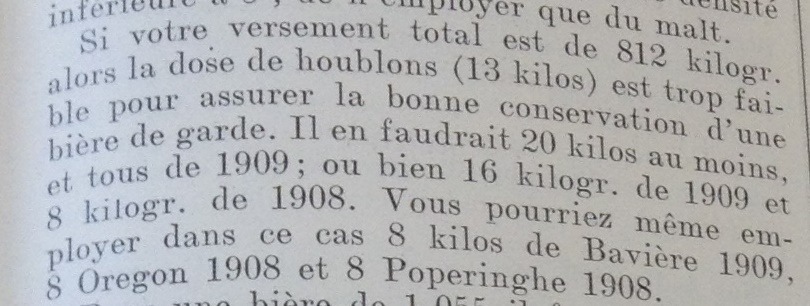
In addition, I thought I should add something new, so here's a new snippet of something quick - the sort of thing that I'd usually put on the FB page. This comes from Petit Journal du Brasseur in 1910, where a brewer is asking about brewing a bière de garde with an OG of 1.055 for serving in summer (note that bière de garde is used here as a general term for an aged beer, not for the French category Bière de Garde). The advice follows general advice for this sort of beer for the time (for example, suggesting 100% barley malt, though as the gravity is above 1.050 perhaps some unmalted grain could be used) but with some good insight.

I think the discussion of hopping is a good section to highlight here as there are a couple important points. First, they note hopping rates need to be sufficiently high for the beer and suggest at least 20 kg for 812 kg of grain. This hopping rate is pretty high (on the order of 50% higher than lambic at some modern breweries). Unfortunately the batch size isn't given, but making efficiency assumptions based on other beers of the time, this is probably roughly a hopping rate of 500 g/HL (an earlier version mistakenly said 500g/L, see the hopping table in this post for notes on conversion factors here). This highlights the importance that brewers of the time placed on hopping beers for aging at elevated rates.

Second, there is discussion of using hops of multiple years. So potentially a brewer could be using aged hops in their beer, but the volume of aged hops suggested would be roughly doubled to replace a portion of hops from the most recent harvest. I like the information here regarding aged hops v. fresh for hopping rates as well as the context that the information gives - brewers may or may not be using aged hops for beers destined for aging that weren't lambic. Finally, the post discusses the possibility of using hops from Oregon. The use of US hops shows up elsewhere at this time in Belgium but I don't think I've talked about it before. So this is a good time to point out that US hops were used by some brewers in Belgium in the early 1900s.

Mention of hopping rates, age and origin (PJB 1910).

Links to the previous FB posts:
Here is a compiled list of posts from the blog's FB page. This is organized by topic, with the original source and posting date, and any other notes. I'll try to remember to update it as I post more on the FB page.

Lambic, Faro, Bière de Mars, Geuze:
Saison and Belgian bière de garde:
(As noted above, there bière de garde can mean different things. The differentiation of the Francophone Belgian use of the term bière de garde and this term used to describe distinct beers from the North of France is discussed a bit more in this blog post)
Other:

Monday, October 3, 2016

What is Grisette part II - updated and abridged

Grisette has become a defining element of this blog since writing my first post on the topic (What is Grisette) about a year ago. This post marked the start of seriously focusing on digging up historic sources to understand what grisette was. At that time I had been watching pro brewers around me and elsewhere in North America applying the name to wide range of beers without any real understanding of that it meant. This is because basically nobody knew what it meant with any detail. People had ideas, myself included, but at best they were all based on a couple pages of information in modern English-language sources. I don't mean to downplay the value of those sources, which focus on other beers, as they present great info. And they played a prominent role in keeping grisette alive/in the minds of brewers. Many of us wouldn't have heard of grisette without those books and  I've even talked to a European professional brewer who learned of the style through Farmhouse Ales by Markowski. But for a more full understanding, excepting the information from those who drank historic grisettes such as Leon Voisin of Brasserie Voisin as quoted in Farmhouse Ales, the information in these texts all came from historic Belgian sources that are out there somewhere. So I wanted to dig those up for more details.

What it looks like when I try to organize thoughts on grisette.
This research on grisette also took me to 1800s and 1900s Belgian primary and secondary sources on other historic beers, which has now become a main focus of this blog. I expect to move more focus in those directions and let my mental organization of thoughts on grisette slip a bit. With grisette, for blog posts and especially for presentations/interviews, I would spend a lot of time working to build the information I had into an organized structure. With a recent presentation in Vancouver and one more grisette event coming up - a podcast/radio recording - I am going through this again. And I decided I should use the opportunity to transfer the same organization to the blog.

My first post on the topic was mostly an organization of what info there already was available in English, including the conflicting pieces of info, and a beginning analysis of labels. This post has by far been the blog's most successful and I think it did a good job of setting me up for what was to come with the historic sources. But the real substance of my research came in later posts and presentations. Unfortunately those posts have seen many fewer reads and not all the presentations are available to everyone, so I think some of the later work I've done to update and expand upon what grisette was may be lost to many. Similarly, the recipe I posted previously was brewed before I all of the more serious research (as was mentioned in that recipe post with some caveats). I still feel that recipe fairly accurately could produce a grisette, but I think you could also make a more "grisette-y" recipe. I gave a more grisette-focused recipe in my talks here and there including my NHC presentation, but again, this is not available to everyone. So I'd like to update that first post and recipe with the subsequent research I've done, in a more clear, concise and universally accessible way.

A lost grisette - label form Jacques Triffin.
I expect there could be more posts on grisette to come for this blog, and I'll certainly keep looking for info on the style, but with less focus than before. This summary will serve as a brief overview of what I know now before I shift focus to other topics. Much like the previous posts, this info is built on what I have seen and extrapolating from there, so parts of this understanding may be refined/changed as I learn more. So here it is: What is Grisette, part II. This might read a little choppy as I'm trying to keep it pretty short and quick. If you are interested in more information, these other posts from the blog and recordings of interviews/presentations (below) go into the information in more detail. These will also be linked again in the rapid fire-style list of grisette characteristics below where they are relevant.
Grisette Fundamentals

What: A fairly clear pale wheat beer that was a refreshing drink in the summertime. The beer was generally but not always lower strength. There were multiple classes of grisette. Ordinary grisettes were fundamentally designed to not be aged. There were aged versions of girsette that changed some of the fundamental structure to benefit aging, but in general it is not a beer for aging, both in recipe formulation and practice.

Based on the hopping rates and lack of aging as well as the historical descriptions, I don't think grisette would have been an acidic beer. Some examples of certain classes from some producers may have had some, but on the whole it seems from the record, including descriptions of the beer, that grisette was not an acidic beer. Multiple texts make a point of noting that the brewers who know how to make grisette were few and didn't like to talk about how they make it, so there isn't a lot of info.

Where: Grisette comes from the Hainaut province of Belgium, and specifically the earlier info I've seen comes form Scheldt and Dender river areas. Bigger cities in the Hainaut province like Charleroi and Tournai had grisette brewers at one point, as well as many smaller towns in the province.

When: I believe grisette started in the 1700s. The earliest source I have seen is from 1812, which mentions a brewery that has established itself via it's grisettes. This brewery was distributing the beer, at least somewhat locally if not also exporting, suggesting: a) they weren't small, b) they had been making grisette for a while, and c) people liked to drink it.

Ingredients

Hops: This post goes into more detail on this. Belgian (likely Belgian landrace hops, which are no longer in much production) were probably generally used. Likely coming from the Hainaut province, though possibly from Aalst or Poperinge for the bigger breweries/those who could afford these hops. Some brewers, especially those making higher classes of grisette, would also have used imported hops at times such as German (Hallertau) Czech hops (Saaz) and English hops (East Kent Goldings). Some general historic sources of the time suggest that German hops were not always thought to be the preferred choice for imported hops. On the order of 3-4 g/l for an ordinary grisette is the right sort of level. Hopping was generally balanced toward bitterness rather than flavor.

With Blegian landrace hops no longer around much, I used Czech Saaz.
English hops would also have been a historically accurate choice.
The beer may also have been dry hopped by some producers. If so, this was probably with a fairly
low dose (<1 g/l) and with better quality hops. So a producer, at least one who could do so, would have favored Czech or English hops for this. Dry hopping would have been done at storage/serving temps after fermentation, probably with a reasonable contact time.

Malt: Grisette was a wheat beer and the wheat was malted. I have seen no mention of grains other than wheat and barley in the historic grisette literature. I think one could possibly add some other grains to their beer, though the more those other components express themselves in the finished beer, the less closely it would follow historic grisette. The breakdown given in Pelset's 1874 text, the one source that goes into detail on the beer, is to use roughly 88% malted barley (spring 6 row) and 12% malted wheat. The wheat was more of a chitted wheat with very little germination time and the kilning temperatures were very low. Not far away from wind dried malt. Other sources mention that the barley would have been a winter 6 row. Given the nature of the beer, a spring 6 row is probably better.

Yeast: In short, I have no clear answer. I think one of the terms used to describe yeast character for this beer, both by me and other sources, can be confusing - 'clean'. A clean yeast profile can refer to a more flavor-neutral yeast in Saccharomyces comparisons (something toward a lager or American ale strain compared to a more expressive yeast like many Belgian strains, especially saison yeasts). Alternatively, clean can be used to describe pure Saccharomyces beers from brett beers.

Grisette wort ready for fermentation.
There are a couple things about grisette yeast/fermentation that I am sure of. 1) They were ales. 2) Based on this, for most of their history they would have been mixed-culture beers. 3) The average grisette was not an aged beer. Therefore this mixed culture wouldn't get a chance to express itself much.

I find no clear meaning to 'clean' as it refers to grisette. They certainly would have been 'cleaner' than saisons for most of their shared history because grisette wasn't generally aged enough for the mixed culture to express itself while saison was an aged beer. So a grisette that comes across as a Saccharomyces only beer, or perhaps with just a hint of additional yeast or bacteria, is definitely cleaner than historic saison, which was a beer that often could have had a final flavor profile with quite a bit in common with lambic.

So based on what I have, I think one could make a grisette with a saison yeast that is 'clean' in the sense of not having any or much expression of brett or bacteria as well as one with a yeast that is 'clean' in the sense of less Saccharomyces expression than a saison yeast. I think there is a case for both to have some accuracy/validity and I don't feel I can recommend one over the other.

For my personal tastes, I'll lean toward the former generally. I'll also add these two bits that support a saison or saison-like yeast. Firstly, in Farmhouse Ales, Markowski states that oral accounts from those who drank grisette describe the beers as saison-like. And secondly, the modern Belgian (and French) brewers who know beer history use saison yeast when when they make grisettes. They make these beers rather irregularly, but De La Senne has been known to make some (including one with Thiriez).

A recipe:

This recipe reflects historic research but it is shifted towards modern ingredients (no landrace Belgian hops, and also some grain/malt substitutions that I think are reasonable) and also slightly by my personal tastes (mostly when it comes to hopping). So it is a 'modernized' grisette recipe. I am adding more finishing hops than I think would have been used in historic grisette. I am also not using enough bittering hops, but that is probably partly balanced out by hop quality. I could post here what is listed in historic texts for recipes but they are incomplete and I haven't brewed exactly what is listed. And based on how much ingredients have changed between then and now, I'm not sure that such a recipe would have much value. Another caveat that I bring up regularly when talking about historic beers is that they are heterogeneous entities within time across different producers as well as through time. There is not one absolute answer for what a given beer was. And finally, I'm not comfortable putting a recipe up here that I haven't brewed in case it is way off when using modern ingredients. But if you really want that and enough people hassle me for it then perhaps I could be convinced to do that.

So here is a recipe I think accurately reflects much of historic grisette with some small exchanges to bring it into the modern world. If one were to 'modernize' grisette, I think it would modernize in this direction. If you wanted to make this recipe more like historic grisette, you could drop the late hopping rate (or eliminate late hops altogether) and increase the bittering hops. The wheat is also higher than the ~12% listed in Pelset.

Malt #47 during testing and selection at Doehnel Floor Malting.
Target OG: Around 1.034
FG: Around 1.006, depending on yeast, grist, and mashing
ABV: 3.5-4%
Calculated IBU: ~30
SRM: Around 3

Grist: For a base I am using a locally sourced and somewhat unique malt. I'm sorry this isn't especially helpful for those looking to use the same, but here is some reasoning for why I choose it and some ideas for substitutions. I am choosing it for three main reasons: 1) it is a good malt/I like the way it tastes, 2) it is local, and 3) I think that while it is a 2 row rather than a 6 row, in certain respects it is more similar to historic malts than many modern malts. It is a feed variety, so not malting specific. It has a high amount of husk material per kernel. This is clear when chewing on the grains, but can also be noticed from holding and breaking kernels. The protein is above typical British malt levels and in the range of/on the higher end of Continental European malts. This specific malt is also a bit undermodified and has a low friability and high B-glucans. It is the same color range as a continental European pils malt.

If you are looking for something unique/with these sorts of specifications, check to see if you have a local/somewhat local craft maltster. These maltsters are more likely to be using less typical grains and/or make more unique products. If you wanted to use a more major commercial malt, you could source a commercial 6 row pils from some suppliers. Otherwise a continental European 2 row pils would still be fine and make a good beer. Generally speaking we won't be getting exactly up to historic grisette on the raw ingredient end so my philosophy here is to not stress much about it and choose ingredients with intention to either make the best beer, or approach historic beer (possibly both) depending on your tastes and goals.

Racking the beer onto dry hops.
79% Doehnel Floor Malting #47 - An undermodified spring 2 Row feed barley malt (variety - Austenson).
14% Malted wheat (I used N American white wheat malt, but European wheat malt might be a better choice if you have access to it).
7% Flaked wheat - these two are used to try to emulate a chitted wheat. If you have chitted wheat you can replace both wheats here with that.

Hops: Using Saaz would probably not have been common at many standard historic grisette breweries, though they may have been used in higher-class grisettes. As mentioned, to make this more historically accurate you can shift the hops earlier in the boil. Additionally with Czech hops, depending on the brewing season (see the hopping grisette post) and the category of grisette, the amount may be a bit lower. If you want to follow Pelset's info more closely, perhaps you could do ~3 g/l Saaz to bitter and no finishing hops. But I'm not sure that would make the sort of beer I want and I haven't tried it yet. So here's what I do:

2 g/l Czech Saaz boiled for 60 minutes (targeting ~18 IBU)
2 g/l Czech Saaz boiled for 15 minutes (targeting ~9 IBU)
Dry hop (optional): 0.5 g/l Styrian Golding for ~5 days. This is quite noticeable in the finished beer and you could experiment with going lower.

Mash: This is informed by the grains I am using, historic Belgian mashing in general, specific grisette mashing, and modern Belgian mashing. I don't have a specific and complete mashing profile for historic grisette at the moment.

My B-glucan rest.
This is very thick to account for additional infusions to come.
-Dough in in the B-glucan range (something like 108-113 F / 42.2-45 C), 10 min rest
-Raise to a protein rest by infusion (something like 125-131 F / 52-55 C), 15 min rest
-Raise to saccharification by infusion (something like 149 F / 65 C), 50 min rest
-A Belgian brewer would probably then do a high saccharification step around 162 F / 72 C or so (possibly in conjunction with a first sacch step being shorter than I did) and/or a mash out close to denaturing enzymes but probably at a low enough temp where you would still get some conversion for a bit. I leave it here and don't do a mash out.

Boil:
90 minutes. Historically this could have been even longer. Probably not much shorter, and more likely longer than shorter.

Yeast and Fermentation:
The fermentation potential (to use a saison yeast or not) is discussed above and I have discussed aspects of it in my interview with Basic Brewing Radio, my AHA HomebrewCon talk, and this quick interview with Basic Brewing Radio at HomebrewCon (see this FB post).

Recently I have been using the Thiriez yeast, cultured from a bottle, and I like it quite a bit. Otherwise I am partial to a blend of 3711/3724 (favoring the 3724) if you want to go in  more saison yeast-driven route. If you don't want to go this way, I like Wyeast 3787 fermented cool for beers of this nature. Those are just some ideas, and you should use either your favorite saison yeast or blend, or your favorite more neutral Belgian ale yeast.

A head-to-head tasting of 3 different grisette homebrews.
With Thiriez yeast I pitch around 68 F / 20 C and raise to 72-74 F / 22.2-23.3 C over the first 3-4 days. I let a warm primary go for 5-7 days and then I let it return to room temp (for me this is about 64-66 F / 17.8-18.9 C) for 5-6 days. If I am dry hopping I rack on to the dry hops around day 5-6 and I give about 5-6 days of contact time on the hops at room temperature. I am generally bottling at 10-14 days. I'll let bottles condition for a couple weeks before drinking them.

You might find a different timeline and temperature range is best based on your yeast choice, but overall grisette is generally not a beer designed for age and something like 3-4 weeks grain to glass (at least when you start drinking it) is probably not far off what would have been done. Some grisettes were aged longer and some may have been consumed even sooner, so you can play around with this timeline a bit. But for a young/ordinary grisette I would try keep the grain to glass time pretty quick.

So there's a rundown for now, balancing being quick with being thorough. I suppose now all that's left is for you to take this info and brew your own version, following more or less closely depending on your taste preferences and goals. And then drink it. Cheers!

My latest batch of grisette following this recipe.
De La Senne / Thiriez Birthday Session grisette.

Tuesday, June 28, 2016

Categories of grisette and grisette strength

This post,which builds on some of the thoughts and label analysis presented in my 'What is Grisette?' post and my talk at Homebrew Con 2016, will dive into what information I have about the the general strength range that a historic grisette falls into. As usual there are still questions, but hopefully this helps to make the identity of grisette a bit more clear and helps you choose what strength to make your grisette. Also, as with the previous post about hopping grisettes, this builds off of an incomplete set of source material which relies heavily on Pelset's 1874 book. This text, while fairly thorough, has some inconsistencies, leaves some stuff out, isn't always clear, and in the end is only one source from one point in time for >100 years of beer brewed by many different brewers. The book is also on the earlier side of grisette info compared to other info out there (personal accounts from people who remember grisettes before they disappeared and labels, both of which would reflect mid 1900s grisette).
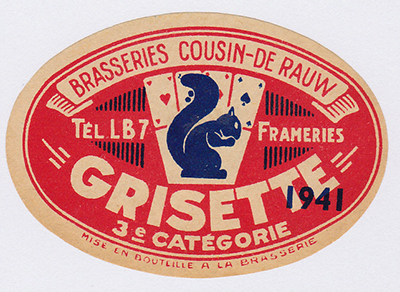
A Cat. 3 grisette and...

To start this off, I want to look at the more modern sources that today's Anglophone brewers might be familiar with and what they say about grisette in regard to strength. These are Farmhouse Ales (Markowski, 2004), Brewing with Wheat (Hieronymus, 2010), and (most likely via Farmhouse Ales rather than directly) Belgium by Beer, Beer by Belgium (Perrier-Robert and Fontaine, 1996).

-Farmhouse Ales cites Leon Voisin, retired brewer at the old Brasserie Voisin (see the saison label below) to say that grisettes would have been 3-5% beers. Shortly thereafter Belgium by Beer, Beer by Belgium is cited for an OG of 16.3-17.5 Plato.

a Cat. 1 saison from the same brewer
-Brewing with Wheat (citing Pelset, 1874) gives a gravity range of 10.2-11 Plato and mentions that there were three classes of historic grisette: young/ordinary grisettegrisette de saison, and grisette supérieure.

-Belgium by Beer, Beer by Belgium, drawing information form Pelset 1874, gives an OG of 6.5 to 7 degrees Belgian, which works out to 16.3-17.5 P or 1.067 to 1.072.

Excerpt from Pelset, 1874 mentioning gravity.
Some of this is in general agreement and some is quite different. To try to figure that out let's look at the original source material for Brewing with Wheat and Belgium by Beer, Beer by Belgium. This source is Pelset's 1874 book on grisette. Pelset gives the three classes of grisette mentioned above and gravities for the first two classes of grisette. For the third the author mentions that the later runnings were not mixed in and instead were used for a small beer. The section dealing with gravity, shown at left, gives the following:

Young/ordinary grisette brewed in winter: 6 degrees
Young/ordinary grisette brewed in summer: 6.25-6.5 degrees
Grisette de Saison: 7 degrees

Here's the source of confusion: these units are "degrees in an ordinary brewer's scale". At that time there were three primary units of degrees in use: Baumé, Balling, and Belgian. I don't have a strong handle on which would have been the most common in Belgium. It probably depends a good deal on where/when a brewer was trained, which would be influenced by scale (if they were more of an industrial brewery or a small local brewery). As mentioned previously in this series, the sources available are generally biased toward industry and grisette, if its roots are in mining, is a beer with an inherent tie to industrial activity. For reference, Lacambre (1851), one of the seminal books on Belgian brewing from the era (focusing on more large scale brewing activity), uses Baumé.
Results from an analysis of grisette labels, June 2016.

Given the gravities from Pelset (which are referenced to 10 degrees Réaumur, or 12.5 C), here are the equivalent gravities in OG at 20 C / 68 F:

6 Baumé = 1.042
6 Balling = 1.022
6 Belgian = 1.060


This is a big range, and only one of these three possible units is what Pelset meant. To try to determine which type of grisette would have been most common in the mid 1900s I looked through a collection of historical labels from breweries that closed before the mid 1990s, compiled and digitized by Jacques Triffin. The results from that analysis is in the tables at right.


Results from an analysis of saison labels, June 2016
While labels don't necessarily give clear information about recipes/characteristics, there is some goon insight hidden in there. First, some of the labels list a category of beer, which is the strength class of the beer (which to my understanding is for tax purposes, though it also conveys the strength to the consumer). Looking at modern beers, some Belgian beers with OGs in the realm of 1.050 still list category 1 on the label (see Girardin lambic). Categories like these are also used in Dutch brewing. In modern Dutch beer:

Category 1 beer would be 1.044-1.063
Category 2 beer would be 1.028-1.044
Category 3 beer would be 1.004-1.028.

Some historic and modern Belgian beers list category S (Supérieure, see Seizoensbrouwerij Vandewalle below as an example). In some historic labels this is listed along with Cat. 1, so this is either at or above Cat. 1. For the purposes of this analysis I have combined it with Cat. 1.

A cellar-matured saison. Keep it lying down and serve in a basket.
Brasserie Voisin's 'old' saison.
As you can see, the grisette labels cluster toward the lower end of the strength categories when the category is listed (given the caveat that not many list the strength) while saison clusters much more toward the higher end. The grisette labels were also more likely to mention something about being a table bière or a bière de menage (house beer) than saison. While grisette labels didn't mention anything about being old beer, this was not uncommon on the saison labels. Labels not listing some of this info are an unknown, but with the information given this supports that at the time period of these labels (many of the breweries in the collection closed in the mid 1900s) grisette was a lower strength beer that wasn't aged while saison was stronger and more likely to be aged. This is also true for paired labels (grisette and saison labels from the same brewery). Though with the range in both beers, it is clear that these beers were still heterogeneous and would vary in factors like strength and aging between different producers of the same time range.

Therefore, though there is a lot of good historical cultural insight in Belgium by Beer, I think they are mistaken with the OG of grisettes. That range is well out of line with the ABV range quoted in Farmhouse Ales and it also doesn't agree with the label analysis. Over the time period from the mid/late 1800s to the 1900s, gravities of Belgian beer were not dropping significantly (excepting during the wars) and in general gravities of average beers were rising. So it is unlikely that the gravity of grisette dropped significantly between Pelset's text in 1874 and the labels, mostly coming from the mid 1900s. The interpretation of degrees as degrees Belgian simply doesn't line up with the other sources.

Taking degrees Belgian off the list then we are left with an OG of either 1.042 or 1.022. If we then assume that the historic Belgian category system is roughly in line with modern Belgian and Dutch levels (and perhaps this is a bit assumption, though I think it is not likely that the categories have grown significantly weaker from the mid 1900s to now), a category 3-2 beer would be somewhere in the range of the 1.020s to 1.030s, maybe into the 1.040s. This matches with both the remaining Balling and Baumé gravity scales, though these degrees fall toward the low and high extremes respectively based on the expected gravity range from label categories. If I had to choose one I'd probably lean toward 1.042 for a couple reasons. First, that matches the units of Lacambre, 1851. Second, degrees Balling would put grisette de saison in the mid 1.020s, which is too low for a bière de saison. And finally, interpreting the units as Baumé matches the interpretation given in Brewing with Wheat which likely came from Yvan de Baets, and he is pretty informed on these sorts of things.

A Cat. S beer from Vandewalle.
However Baumé doesn't quite line up with the labels listing a 3rd category beer. I'm not sure what to make of this, so perhaps it is safest to target a gravity range somewhere in between the two. Splitting the difference I think it is reasonable to base grisette in the 1.030s, possibly toward the middle to higher end to comfortably hit 3-5% abv on a beer with reasonable attenuation but without the benefit of prolonged mixed-fermentation to increase attenuation further. For this reason I tend to target gravities around 1.035 for the average (ordinary) grisette personally, but I think you could have some substance to an argument that beers which are both stronger and weaker could accurately be labeled grisette, depending on time period and grisette subcategory.

But what about grisette de saison and double/supérieure grisette? Brasserie De La Senne and Brasserie Thiriez brewed a grisette which Yvan de Baets told me was targeting the grisette de saison strength. This beer came out at 5.3% (DLS brew) and 5.5% (Thiriez brew), so guessing a bit on the FG this puts the beer somewhere around 1.045 OG. This fits with normal grisette being in the mid to upper 1.030s if grisette de saison is about 17% stronger than ordinary grisette, as stated in Pelset's text.


I don't have a lot to go on for double/supérieure grisette. Two distinct double grisette labels showed up in the label analysis but no strength classes were given on those labels. With grisette de saison in the mid 1.040s I think a double grisette has to be above 1.050, and probably not over 1.060, or at least not much over 1.060 given general beer strengths of the time (though this upper limit is purely a guess).

In closing, I want to say something about how this grisette strength info plays into the identity of grisette in the modern world. Two things are clear:

1) based on the labels, grisette was brewed at the same time as saison from some of the same brewers
2) It seems that most grisettes were lower strength, but that is not necessarily true. There were saisons brewed at the category 3 level and at least one grisette at cat. 2 (not to mention the double grisettes, which don't specify a strength but according to Pelset would be stronger than beers of roughly 1.045 OG).

Therefore it appears that there is something in the identity of grisette that, historically at least, made it different from saison more than just being lower strength. I think most grisettes were low strength beers, and if you were going to try to make a grisette it is probably best to start in that range (mid to upper 1.030s for a standard grisette by my estimation). Grisettes definitely clustered to lower strength than saisons in the label analysis so I do think that is part of the story (at least that grisette wasn't a beer requiring age and commonly brewed to as high an OG as saison). But there are other aspects that define grisette and help to differentiate it from historic saison. So far in my research those seem to be a requirement for malted wheat, generally lower hopping rates than saison (but still high enough to be noticeably hoppy), and beers designed to not be harsh/bitter/astringent when they are young (as both the grain and hopping rates of saison might contribute to).

The differences get murkier in the modern world, where saison is generally a softer beer than historic recipes suggest and most saisons are not mixed fermentation or are not aged long enough to give mixed fermentation time to express itself. But what I've seen so far supports grisette as a hoppy beer (but probably not astringently so) and does not support grisette as an acidic beer. Grisettes would not be sweet beers, as is the case from the one regular producer in modern Belgium, and from what I've seen it is best not to go for acidity when brewing grisette.

Other posts on grisette:
What is Grisette?
Grisette Recipe
Hopping Historical Grisettes
What is Grisette part II


Sunday, June 19, 2016

Hopping Historical Grisettes

Following up on my talk at the National Hombrewers Conference (audio and slides will be available here for AHA members), I want to take some of the new info I presented in the talk and expand on my previous grisette posts (What is Grisette and a Grisette Recipe). So I'm starting a new series of posts diving into various aspects of historical grisette production. For those that didn't make it to the talk, these posts will cover a good amount of what was there. And for those who made the talk, these posts will hopefully add some new info to what I presented, or at least give a good platform for discussion of the topics with a different organization. To start this all off I'll talk about hopping grisettes.

Riding (an improperly-adjusted rental bike) through hop country. Ph: J Young
When it comes to the specifics here (hopping rates) I only have one good source: Pelset’s 1874 text on brewing grisettes and pale beers. It is always risky to draw large historical generalizations from a few sources, and that is the case with grisette as a whole given what I’ve been able to find. And it is especially true here for hops. So for now this is the best I can do, and we’ll just need to keep those caveats in mind. The info will be updated if I am able to find more sources.

Before getting into grisette specifically I want to spend a bit of time talking about hops in general. Within Belgium, the two main hop growing regions were, and still are, around the West Flanders town of Poperinge (quite close to Westvleteren and also the French Border) and the East Flanders town of Aalst (which falls rather close to the Pajottenland in Flemish Brabant). These hops were regarded as being of higher quality than Belgian hops grown in other regions, but generally Belgian hops were thought of as inferior to hops grown elsewhere in continental Europe and in England. 

Multiple recommendations are made in Le Petit Journal du Brasseur for brewing saisons and bières de garde with English (the East Kent region shows up multiple times) and Bohemian hops. (Note that bière de garde here refers to general beers for aging and not the family of beers known by this name in Nothern France.) The journal suggests these hops for their superior flavor contributions and less aggressive bitterness. Bavarian hops were well regarded also but were thought to give more antiseptic properties and a stronger bitterness, which may not have been desirable in all beers. Especially those which the brewer wanted to become acidic. These trends may reflect some inherent differences in the varieties of hops, but I suspect much of the difference is strongly influenced by the quality of the hops in terms of cultivation rather than/in addition to differences inherent in the varieties.

Ad for Groene Belle hops from PJB 1929
In the 1800s and early 1900s, popular Belgian hop varieties included Coigneau, Groene Belle, and Witte Rank. Coigneau (as I've talked about before) is notable as being a main hop used in lambic production. And from what I’ve gathered it seems to have been the main Belgian hop in the late 1800s. In the early 1900s Groene Belle seems to have supplanted Coigneau as the primary hop of choice.

Native Belgian varieties disappeared around the mid-1900s as Belgian hop growing switched to other varieties such as English hops, which are common today in Belgium’s hop fields. These original Belgian hops were very nearly lost forever, but fortunately some Coigneau was recently discovered as having made its way to an English nursery. Groene Belle was used in hop breeding in Slovenia and was also able to survive until today. Both of these varieties are potentially available for purchase in season as plants from a UK supplier. It seems that they are not shipping outside of the UK for now, but perhaps that could change with enough enthusiasm/nagging. But if you really want them you may have to make some UK friends. Whatever the case, it is good news for those interested in historic Belgian beers that these hops somehow found ways to stay alive until modern times and hopefully the availability of plants and/or hops increases.

Hop fields in Poperinge
Pelset gives hopping rates which would depend on the season of brewing and the type of grisette brewed. Before going further, as mentioned in Brewing with Wheat, Pelset describes 3 classes of grisette: Young/Ordinary Grisette, Grisette de Saison, and Grisette Supérieure/Double Grisette. I may go into more detail summarizing these beers at a later date, but for now here's a quick rundown as it pertains to hops: ordinary grisettes brewed in summer would have been hoppier and also slightly stronger than those brewed in winter to counteract the non-ideal summer conditions. Grisette de saison, brewed ‘in season’ so in the wintertime, would have been stronger and hoppier than both summer and winter young grisette. Not many details are given for grisette supérieure, but this would have been stronger still, and presumably more hoppy as well.

I’ve transcribed the specific hopping rates suggested for grisette by Pelset into the table below. For comparison I have also included some info from various issues of Le Petit Journal du Brasseur for saison and bière de garde along with relevant notes about those recipes and calculations I made. Pelset notes that Wallonian hops, or hops from other areas of not optimal quality, can be added as first wort hops while Poperinge or Aalst hops should not be boiled for more than 2 hours in order to not extract too much bitterness. Using a small amount of Poperinge or Aalst hops as first wort hops would be permissible. Non-Belgian hops are recommended for grisette supérieure given its higher quality and price point (more on grisette pricing in a post to come). Other texts from the early 1900s give a rough conversion of 1.5 lbs Belgian (Poperinge or Aalst) hops to 1 lb Bavarian hops. I should note for this table that the exact timings for hop additions aren't always given, but that these hopping rates are for what seems to be bittering hops.

Hopping rates for different grisettes and saisons/bières de garde in the late 1800s and early 1900s.

Le Petit Journal du Brasseur recommends dry hopping grisette with English hops. Bavarian hops are mentioned as being too bitter. Specific hopping rates aren’t given, but are likely low (lower than what it sounds like was done for saison at the time). From this I am guessing that dry hopping rates would have been on the order of 0.5-1 g/l (0.066-0.13 oz/gal), though with everything else here there is not one approach that would have fit everything, so higher or lower rates might also be appropriate.

From what I’ve seen, most grisettes would generally have been consumed young and, save for one mention in one source I’ve found, grisette was never described as a tart or acidic beer. That one source is definitely in the minority, with most others referencing the refreshing hoppyness as the character of note. The higher category grisettes (grisette de saison and grisette supérieure) got some aging time, but overall descriptions are consistent with these hopping rates and the time between brewing and serving of most grisettes resulting in a hoppy beer where the mixed-microbes used in fermentation would not have had a chance to express much acidity in the beer. This leaves grisette as a beer without a lot of mixed-microbe character and with some brighter hop character still around.

It is important to note in closing that all of these hopping rates are for historic beers with historic hops. We don't know exactly what those hops would have been like, but they were probably lower in alpha acid than modern hops, especially the Belgian hops. They may have contributed a bit more of a rough bitterness given the amount of plant material used and the long boils. And, in looking at the table, the origin of the hops can have a big impact on the total recommended hopping rate. 

Ok, that roughly sums up the additional thoughts on grisette hopping for now. Hopefully this was useful for you and keep an eye out for additional posts breaking down specific aspects of grisette.

Posts on Grisette:
What is Grisette?
Grisette Recipe
Categories of Grisette and Grisette Strength
What is Grisette part II

Thursday, October 15, 2015

Grisette Recipe

July 2017 edit: I made this post in 2015 and I've learned a lot about grisette since then. I think this is a fine recipe for a good beer that is similar to grisette, but I think you could make a more 'grisette-y' grisette by following another recipe. For an updated and more grisette-like recipe, please see: What is Grisette part II.

This is a follow up to my What is Grisette post with a recipe for a beer that I felt was a grisette. In June 2015 I gave a talk about saisons at a local brewery and I wanted to talk a bit about grisette (prompted by some of the same factors that influenced the first grisette post). And I felt that if I was going to make claims about what I thought grisette was, and that it was different than what people may have previously tasted, then I had better show up with what I thought grisette was. In order to be able to serve it, I brewed this as a 'pilot batch' for a local brewery. But my continued involvement with this brewery will be focused elsewhere and I don't intend this grisette to go into any sort of one-off, seasonal or normal production in Victoria. So I don't think it will be going anywhere commercially for now, but that's not a reflection of what I think about the recipe. I intend to keep brewing something like this on a regular basis at home.

I brewed this before I did much of the research that went into the grisette post. I said in that post that at the time I was calling this beer a grisette, and I stand by that now. But there are probably some parts about this recipe that might not make for the most traditional grisette recipe. First and foremost is the hopping. This is fairly typical of my approach to hopping saison-oriented beers but it is probably inconsistent with what would have been done historically. My approach to hopping these beers is more influenced by the 'heavy on the late hops' sort of approach found in many North American hoppy beers. But I've been really happy with how this sort of hopping using noble-type hop varieties translates to saison-oriented beers. So to me a 'bittering addition' in most of my beers is probably either a first wort hopping or something more like an old school IPA flavor addition of roughly 45-30 minutes left in the boil. - Sidenote, so far I've felt that translating this sort of hopping to fruitier varieties (like southern hemisphere hops) doesn't quite produce the perceived bitterness that I would like, but that's a work in progress...

The second reason that this might not be a classic grisette recipe is the use of flaked oats. I have no reason to say that this was (or was not) employed in historic grisettes. But with such a low OG beer and highly attenuative yeast, I think it is a reasonable addition to build some body into the final beer while staying lighter with the grist. At a comparable time, wit beers would have been using oats (and to some grisette is described as a type of 'biere blanche', though that likely refers to the use of wheat and pale color rather than any other similarities to witbier) so it is not unheard of for Belgian brewers to be using oats at the time. And maybe oats made it into some grisettes, but I currently have no information to substantiate that so for now I'll treat the inclusion of oats as atypical.

So I stand by calling this a grisette, at least based on the 1900's characteristics that formed the basis of my analysis in the "What is Grisette" post. Unfortunately I don't have any of this left, so I can't sit down and write up some notes. But I did drink a reasonable amount of it. At first (before packaging) I thought it was perhaps too hoppy, but in the end I really liked it. It was crisp, light (quite light actually, perhaps a bit too much so) and had a pleasant hoppyness and bitterness to it. At first I thought it was too bitter, but that passed and I was happy with the level of bitterness. The head retention and appearance were nice - lightly hazy but not obtrusively so. Definitely a beer I would happily drink a lot of. I'll have to re-brew this and come up with detailed notes to know exactly how I'd like to change it, but probably the only thing I'd do at this point is shoot for a touch more malt presence, perhaps by slightly increasing the vienna portion.

The Grisette


Recipe

Brew day: 4-Apr-2015
Batch Size: ~ 12.5 gals (47.5 L) in primary
OG: 1.033
IBU: ~33 (Tinseth)
Transferring wort into my primary fermenter.
FG: 1.001
ABV: 4.2%
Bottled: 12-May-2015

Grist:
71.3% Doehnel #30 Pils malt
13.6% Wheat malt (1/2 CMC, half Weyermann)
6.8% Flaked oats
5.4% Vienna malt (Best)
2.9% Acidulated malt (Weyermann)
-I should note that this acidulated is for a minor pH adjustment and I think the recipe would probably work quite well (and possibly better) without it.

Hops:
40g Slovenain Aurora pellets, 8.0% aa at 45 min left in boil (~17 IBU)
34.5g Hallertauer Tradition pellets, 6.7% aa at 50 min left in boil (~10 IBU)
70g Czech Saaz whole hops, 3.1% aa at flame out, 25 minute whirlpool (~4 IBU)
31g Tettnang pellets, 4.4% aa at flame out, 25 minute whirlpool (~2 IBU)

Yeast:
A blend of Wyeast 3724 (Belgian Saison) and 3711 (French Saison), roughly 75%/25% respectively.

Other:
1 tab whirlfloc
6g Wyeast yeast nutrients
Water: +~95 ppm Ca2+, +~147 ppm SO42-, +~55 ppm Cl- to water that is basically equivalent to distilled to start

Mash: One step at about 151-152 F (66.1-66.7 C) for an hour. This didn't really result in a higher FG than mashing for fermentability, and sort of backs up my experience with 3711. I've always equated this yeast to brett in some ways as I felt that it kept working on more dextrinous stuff, both in the carboy and in the bottle (even when bottling at/below 1.000). And while everybody mentions crazy attenuation with this yeast I hadn't heard much about continued slow attenuation of 'non-fermentable' material after reaching 'FG' until hearing a couple pro brewers talking about it recently. So, in the same way as I'd treat brett, I probably won't go back to mashing higher to try to decrease attenuation with 3711 in the future, and instead will come up with other ways to increase the malt character and body.

Fermentation:
My pressurized racking cane.
This beer was fermented in a de-speared sanke keg. For this batch I just shoved a #11 bung into the top, but that forms a slightly imperfect seal (airlock still bubbles normally and I pressure racked out of it fine). So a bit more O2 may have gotten into the beer than ideal, but the beer was consumed pretty quickly and I didn't notice any issues from O2. It probably helped that I was using noble-type hops. I've since gathered the necessary supplies to adapt the de-speared keg and eliminate this potential for O2 pickup (a tri-clamp gasket that is flat on one side, a short tri-clamp stem and a clamp, see this Milk the Funk wiki page for some ideas).

Because this beer fermented at the brewery instead of at my house in conditions that I know how to control well, the temperature regulation wasn't everything I would have hoped for. But overall it worked out pretty well. The yeast was pitched around 68 F (20 C) and the beer was allowed to free rise/was raised to about 78 F (25.6 C) by day 4. The temp was held in the high 70s (~25 C) for about 10 days or so, and then it dropped to ambient for about 3 weeks. It was then cold crashed for a couple days and bottled/kegged. I used this cane to bottle/keg it (at right), but in the future I'd probably use another racking cane (as described by this Milk The Funk thread, thanks to my friend Shawn for construction help) for that purpose due to the easier ability to adjust cane depth in the fermenter (especially since I could't see where the yeast cake was).

As my research on grisette in ongoing, I'll periodically publish other posts on grisette (which might influence how I'd change brewing one in the future). I'll compile those here:

Hopping Historic Grisettes
Categories of Grisette and Grisette Strength
What is Grisette part II (including an updated recipe)

Wednesday, October 7, 2015

What is Grisette?


(edit Oct 2016: I expand upon and update this post in What is Grisette part II)

This post, which was some time in the making, was prompted by beer naming. This is a very difficult task for many brewers and I don't want to overplay issues in beer labeling or call any specific people out for poor labeling, but I do think that brewers should be thinking about appropriate labels and why that label is applied to a given beer. Labeling terms and beer styles have mutually agreed upon meanings and this is why they are valuable. But when those words are used to describe things outside of the scope of their mutually agreed upon meanings (or when brewers and/or consumers don't know the meanings of the words) then they loose their value. I'll save most of the philosophy and semantics discussion for a potential later post, but in brief, this need for integrity in the terms applied to beers was really brought home to me this past March when, on the same day, two different breweries close to me released a beer that they were calling a Grisette. Grisette seems to be one of the new buzzwords sweeping Belgian-inspired craft beer. It's like the new cool lost and obscure style. While I think grisette is a cool style and I want to see lots of good examples of it brewed, seeing beers popping up with the name grisette can be concerning because not many people have a good idea of what it should mean (both brewers and consumers included). And this is for a good reason - there is very little information out there about it! So consumers might learn grisette to be something that actually shouldn't be represented by the name, but that's all they've seen with the name so that's what they know. These local "grisettes" were, to my knowledge, the first two "grisettes" released in my area. And I didn't think either of these were very Grisette-y. So that got me thinking:

What is Grisette? What does it mean to me? Is that an accurate meaning? What else could it mean?

Grisette Grenier - note the industrial-themed background

After going back and looking through the available information I knew of on Grisette (there's not much), I started a couple discussions with other brewers and beer drinkers who think about these styles (one on the Milk the Funk facebook page and another on the Saison, BdG, Farmhouse appreciation society facebook page, I think you'll have to be a member of those pages to see the discussion). I got some good insight from other brewers and compiling that with the published information I knew about and some reasoned conjecture, here's my take on Grisettes with some historical context:

While Saisons are (historically) beers rooted in the farm, Grisettes are beers inherently rooted in industry and the industrial revolution. They were brewed for miners in the Hainaut province (and possibly adjacent mining areas) in south of Belgium, which until the World Wars was one of the centers of the Industrial Revolution in Europe (see this wikipedia page and the cities mentioned within). The Hainaut province is the same region that saisons come from, and there were likely significant similarities between the two beers. Both mining and farming are rural activities done on (or in) the land with the need for an urban area nearby to sell/process goods and for trading. And in addition both the styles are beers to refresh the workers and, as such, would have been lower strength and would have fulfilled the same basic requirements.

As the world industrialized as a whole, so did breweries. And this would have influenced beers (which influences grisettes as well as saisons). This means larger breweries with better/more specialized equipment and more desire for consistency. And more specific roles and trained people to work those roles rather than brewing being a part time task in the off season. For beer, and especially grisette as it would have been more central in industrialization than saison, this would mean beers trending toward cleaner fermentation and the regular use of certain ingredients rather than more variable recipes. It also might mean that with brewing more as an occupation and less as a role secondary to another occupation such as farming, the amount of time given to each beer for fermentation and conditioning would start to come down, resulting in 'cleaner' beer (by this I mean less influence of slower growing wild yeasts and bacteria and not a reflection on Saccharomyces yeast character, which is often developed and complex for strains common in saison) whether or not 'cleaner' pitches of yeast were used for fermentation. And beers being sold sooner would also lead to brewers wanting to produce beers that were ready to be released sooner.

Malting practices were becoming better at the same time, meaning more consistent and also likely paler malts were available. Consumer taste preferences were starting to shift as beers traveled further and imported beers came in. All of this combines to yield a very dynamic landscape for beer. And as writers of the time still for the most part didn't care about smaller styles of beer being brewed in these rural (though sometimes not so rural) areas of Belgium, there isn't a lot of sound documentation on what was going on.

Some breweries would make both saisons and grisettes in addition to many other beers (see these label collections from Brasserie Bavery and Brasserie Fauconnier for example). It is likely that with the dynamic beer landscape of the time, these styles would have drifted both on their own and in relation to each other. What we know about grisettes from historical records is often contradictory. This could be because authors may be discussing grisettes from different time periods and/or different producers. Beer styles definitely changed over time and grisettes were around long enough to see some of that change. This caveat should be kept in mind for the rest of this discussion, as much of the grisette info I'll reference comes from the 1900s. So perhaps grisette would have been different in the mid 1800s. Differences in historical information could also be because the information at the time was not always accurate/representative and objective or something might be lost in translating outdated/seldom used terms and units of measure. Whatever the case, here's what we've got-

From Farmhouse Ales by Markowski, pp.131-133:

  • No longer produced but used to be fairly common
  • Modern beers in Belgium called grisette are not like historic grisette
  • low abv (~3-5%)
  • light bodied, dry and refreshing
  • saison-like, but with hops giving all of the refreshing quality rather than acidity as well as hops as was possible in old saisons
  • golden in color, clean blond ales
but also
  • OG of 16.3-17.5
  • Amber in color
From Brewing with Wheat by Stan Hieronymus (p.xi, 23):
  • Modern beers called grisette in Belgium are not like historic grisette
  • Disappeared around 1960 (coincidentally around the same time as the major downturn of industry and the subsequent economic downturn of the region)
  • Included malted wheat, around 10% of the grist
  • The wheat was kilned at a very low temperature
  • Grisette was brewed with relatively modern (for the time) brewing techniques
  • Ranged in color from white to brown
  • three strength classes
    • Jeune/young: brewed all year, summer version 'stronger' at 10.2-11 P (1.043-1.046)
    • de garde/de saison: brewed in the winter, 12 P and up (1.048+)
    • Supérior/double: stronger, used first 2 runnings from mash (rest went to a small beer)
  • Fermentation in metal and then wooden barrels
The Brewing with Wheat source is from a text that falls probably on the earlier half of the history of Grisette (the 1870's, source of info mentioned here thanks to Browne and Bitter) and that could explain why there are three versions mentioned there but not in Farmhouse Ales. The Farmhouse Ales info seems to fit best with the Jeune/young Grisette mentioned in Brewing with Wheat. The conflicting Farmhouse Ales description could be discussing the Supérior/double, or there could be something else going on. [edit Sept 2016: at the time that this was written I was guessing that the 1870s were the early half of the history given the info I had available, but was unsure of this as reflected in the original wording. The earliest source I have found so far is from 1812 and mentions a brewery that does at least some regional shipping of grisette, so that puts the likely origin of the style, at the latest, around 1800. Given this info, it is likely that the 1870s were either around the middle of the time range of grisettes or on the later half. Either way, the original point that modern English-language sources which offer inconsistent info could do so due to referencing historic sources from different points in grisette history is valid - grisette in the 1870s would probably have been different from grisette in 1812 and around 1950.]

Old beer labels can also give some insight on grisette. A possible concern about basing this analysis partly on old labels is that I won't really be able to disambiguate marketing speak from truthful information about the beers. Another concern is that I am drawing only from the breweries that are large enough or sufficiently well known to have records of their labels. But given that grisette is by its nature tied to industrialization I am ok with that concern (it may be more of a problem for historic saison studies). Jacques Trifin's website is an awesome resource of old Belgian beer labels and all of the labels I'm showing here come from this site.

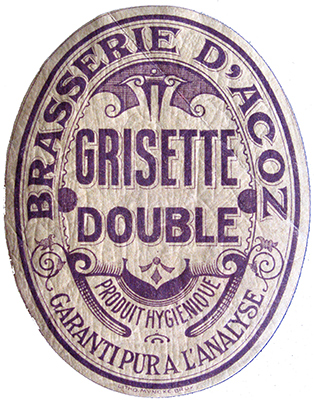
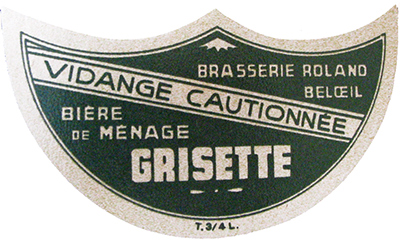
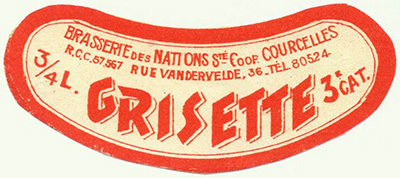
Taking the labels with the above precautions in mind, the old labels for grisette that give a strength indication list 2nd Catégorie or 3rd Catégorie. This category system likely has tax class roots, but it also gives us an idea of the strength range of the beer (see this link from the Netherlands, article 4, also this wikipedia page). According to the modern Dutch categories, a Cat. 2 beer has an OG of 7-11 P (1.028-1.046) and a Cat. 3 beer has an OG of 1-7 P (1.004-1.028).  The specific gravity ranges of such a system have likely changed over time and country to country, but presuming that the categories haven't completely changed, category 2 and category 3 beers would be lower strength than what we would now consider normal strength beer (Cat. 1). Of all the numbered strength categories I saw, there were 3, 2, and 1 corresponding to beers I would expect to be increasing in strength in that order, so that gives us some confidence that the 1900's Belgium system is somewhat similar to the modern Dutch one. If someone knows what specific strength ranges these old Belgian categories meant that would give us a more definite answer, but I suspect it won't be extremely different from the ranges here. There is one label for a beer termed "Grisette double" (see here, note that this brewery closed in 1923, early compared to the other labels here) but mostly when I'm seeing a strength modifier it is 2nd category (see below left), something like table beer/house beer (here as well as Francois and sons above left and Grenier top of the page right) or 3rd category versions (here and here, the same shown below center and right).

Cat. 3 Grisette
Cat. 3 Grisette
Cat. 2 Grisette


Synthesizing this, the bulk of the information seems to be pointing toward a low strength, pale, hoppy wheat beer that would not have been aged especially long, though some versions may have been a bit stronger and aged a bit longer. But it seems that most of the grisettes that we have records of now were lower strength beers. Moving ahead with this, from something in the range of category 2-3, the 3-5% abv sounds about right, with grisettes perhaps more likely falling on the lower end of that range later in their history (category 3 would be on the lower end of that range, or quite easily below it, given the modern Dutch OGs associated with these categories). Unfortunately the labels don't offer any specific recipe info, but we can be reasonably sure that (at least at one point) wheat was a fundamental part of the beers given the info from Brewing with Wheat. Many of the breweries that the labels came from were brewing a number of different beers (saison, pils, bock, brune, abbey beers...) so it seems that in the 1900's at least they were confident working with different yeasts in the same brewery. Along with the general identity of grisette being tied to industrialization, this lends support the grisettes being more of a pure culture fermentation than historic saisons. Because the grisette labels have no indication of being an aged beer, while some other labels of the time do include a note for aged beers (and since it would add cost to a brewery to keep a beer around longer you'd think they would want to advertise it), we can also assume that grisettes were generally served younger. This would mean that the hop character would be more forward than an aged beer of a similar recipe and there would not be much time for bacteria (and in addition wild yeast) development, lending support to the Farmhouse Ales information that grisettes were crisp from hop character and without acidity.

Saison Cavenaile - "matured in out cellars"
This gives us a good ballpark for the sort of beer that a grisette was. I think it is reasonable to think of grisette as a lost branch in the saison family fitting somewhere between historic farmhouse saison and modern saison. Many modern saisons are also more clean (using only Saccharomyces). Modern saison gravities are higher than historic saison, and given the gravity category on saison labels from around the time of grisettes, saison gravities were also higher than those of grisettes. Based on descriptions of "Vieille" or "mûrie dans nos caves" (matured in our cellars) on saison labels, saisons of the time were still beers with more age. With imperfect yeast management this would still allow for the expression of wild yeast and bacteria character, though at the time saisons were also moving toward being pure culture products. In looking at the modern day petite saisons, some of these may have considerable overlap with grisettes. I think a microbially clean (or at least mostly clean) but expressively fermented, shorter-aged, low strength beer with wheat and a more prominent hop profile could definitely be a description of either a grisette or a modern petite saison. To me petite saison is more open to the possibility of lactic acid and/or brettanomyces character, but that may be one of multiple sides of petite saison. So although I don't think the two are interchangeable, I think there are beers out there that could be appropriately described by either term.

A category 1 saison
It would be interesting to get a bit more information on Grisette de Saison as I didn't find anything with that name or mentioning longer aging for grisette in the label collection. That could be something more in line with saisons given the higher gravity and longer aging that Markowski mentions. I'd also like to find out some more info on earlier grisettes. So still some questions remaining. I'll update this post as I find more answers (or if there is enough new stuff then I'll do a follow up post).

Ok, so there's some thoughts on grisette. Here's a recipe for a beer that I was calling a Grisette, at least at the time I brewed it.

Apr 2016 Update: I will be presenting this and continued research on grisette at the 2016 AHA National Homebrewers Conference. Hope to see you there if you are headed to the conference! If not, I am hoping to post a follow with my ongoing research sometimes shortly after the conference.

June 2016 Update: I've started a series of posts expanding on various aspects of grisette based on the research from my NHC presentation. Here are those posts:

Hopping grisette
Categories of Grisette and Grisette Strength
What is Grisette part II