Showing posts with label Process/technical info. Show all posts

Tuesday, January 22, 2019

Spontaneous fermentation and biogenic amines

Biogenic amines (BAs) are a class of biologically-produced compounds that are found in plant and animal products such as cheeses, cured meats, and other fermented foods. The names of some specific BAs may be familiar, for example histamine, and others may illustrate the sorts of characteristics some BAs have (strong bad smells), for example putrescine and cadaverine. As the names of these latter two suggest, some BAs are associated with rotting material. In higher levels BAs can have health impacts, but I won't be discussing any of that. If you want more health-related information on this, check out this great complimentary post by Bryan at Sui Generis Brewing.

In beer, BAs can originate from raw ingredients and can also be microbially produced during fermentation. Especially in fermentations that are not pure cultures of S. cerevisiae, much of the BA content of beer can be formed during fermentation. This post will focus BAs in spontaneous beer by looking at data of BAs in lambic, with an emphasis on microbial BA production points, how this may impact the flavor and aroma of spontaneous beer, and how production can be minimized without inoculation (i.e. while maintaining a spontaneously-fermented beer). I won't go into much lambic background in this post, so if you're unfamiliar with the process and/or fermentation progression of lambic and other spontaneously fermented beers, then I recommend starting with this page on the Milk the Funk wiki and these pages (here and here) on lambic.info. You can also find all of my previous posts on lambic (history, hopping, IBUs, carbohydrates, commercial brewery/blendery visits, etc.) here.

A coolship being filled
As with my other posts on beer science, this might be a bit dense for those not so interested in science. Here is a simplified summary if the details are a bit too much and/or you're not interested in that part:

Biogenic amines seem to be produced in two different phases in spontaneously fermented beer - one from enterobacteria in the initial weeks and one from lactic acid bacteria after about 6 months. BA production in the first stage may be controlled/limited by pre-acidifying wort. Differences in BA production in the second stage may be due to differences in specific strains of lactic acid bacteria, as not all can produce BAs. There aren't enough data to be sure, but BAs produced in the first stage could impact the flavor/aroma of spontaneous beer.

Biogenic amines in lambic

The data sources
I will be primarily discussing two studies on BAs over the course of lambic fermentation - Gasarasi et al., 2003 and De Roos et al., 2018. The former followed the fermentation of un-acidified wort for 400 days, and also followed fermentation of wort which they pre-acidified with 5% of a very acidic beer. This beer was prepared from the previous brewing season by pitching wort with pure strains of lactic acid bacteria. It does not seem that this ~6 month old acidic beer was sterilized before using it in the next season at a level of 5% (contributing about 1g/L lactic acid). This second beer was followed for a total of 60 days. If this acid beer wasn't sterilized, that is unfortunate because it means the beer is no longer spontaneous. The authors also briefly mention tests with simple pre-acidifying with lactic acid, which they say resulted in a reduction of BAs, but unfortunately they do not show the data or discuss it further. The second study (De Roos et al., 2018) followed two different 660 L casks of lambic from the same brew from the time the casks were filled until they were two years old. The wort for these casks was pre-acidified to pH = 4.3. Finally I am including data from two different studies on finished lambic & geuze - Izquierdo-Pulido et al., 1996 and Loret et al., 2005.

Stage 1 - Initial days and weeks
Looking specifically at beers of spontaneous fermentation, there appear to be two periods where BAs are produced. The first point occurs early in the fermentation where enterobacteria are active, beginning in the initial day(s) after cooling and lasting for the first week(s) (e.g. Van Oevelen et al., 1977; Spitaels et al., 2014; De Roos et al., 2018). At this point in the fermentation, no significant attenuation has occurred so simple sugars are available and alcohol is absent. The pH is also higher at this early stage. During this stage the primary BAs produced are putrescine and cadaverine.

Variability is seen among available data for putrescine and cadaverine production at the start of fermentation. See, for example the differences in cadaverine and putrescine between the filled green circles (Gasarasi et al., 2003 data of lambic wort which was not pre-acidified) and the open green circles (Gasarasi et al., 2003, lambic wort which was pre-acidified). Additionally, the Gasarasi et al., 2003 un-acidified wort shows much higher putrescine than the De Roos et al. (2018) data. It should be noted that this comparison is between different batches of lambic from different years and from different producers, so there could be additional sources of variability. The difference for putrescine may be important, even if cadaverine levels are similar, as putrescine is more likely to have an impact on the taste and/or aroma of lambic at the observed concentration levels. This is discussed in more detail in the taste section below.

BAs in fermenting & packaged lambic. Data in black squares are from final products. An age was chosen
(~800 days) to include them in the figure and does not reflect their actual age (which is likely much older).
The ability of pre-acidification to limit BA levels in the initial production phase is because pre-acidification can limit and/or shorten the period in which enterobacteria are active in the wort. Both the Gasarasi et al. (2003) and De Roos et al. (2018) studies highlight the potential of wort pre-acidification to limit BA production in lambic. Gasarasi et al. (2003) note that pH > 5 and cooling to T < 15° C may result in elevated BA levels, and they say that adding 2000 mg/L lactic acid to wort reduces BAs but does not completely prevent BA production. A study on industrial lambic production where the wort was acidified to pH = 4 with lactic acid before fermentation also demonstrated that pre-acidification can eliminate the enterobacteria phase of fermentation (Spitaels et al., 2015).

A stainless steel coolship
Takeaways for brewers from the first phase
For brewers wishing to pre-acidify their spontaneous beers, these studies provide some possible starting points. Note that I haven't tried any of these myself, I'm just summarizing the advice of the papers. The specific levels mentioned here (2 g/L lactic acid in one study, pH = 4.3 in another, which took a bit more than 1 g/L lactic acid; the latter here being what one lambic producer does) may be a good starting point. Using a lower pH (pH = 4.0, as used by an industrial lambic producer) may further reduce BA production by preventing the enterobacteria step. 2 g/L lactic acid sounds like quite a bit to me, considering Van Oevelen et al. (1976) report ranges of about 2-3.5 g/L lactic acid in finished bottle fermented geuze. As a comparison, the lambic studied in De Roos et al. (2018) finished with 4-5 g/L lactic acid, and the bottled gueuze samples from Spitaels & et al., 2015 finished with about 4 g/L lactic acid or more. Depending on where the beer finishes, acidifying with 2 g/L could mean half or more of the lactic acid in the final beer is from the pre-acidification.

Finally, blending in old acidic beer around 5% (for very acidic beer) before fermentation could be a good starting point. Depending on how you feel about spontaneous fermentation, you may want to do a quick sterilization of this to prevent inoculation with microbes from the old beer. Or you may view this as beneficial for your beers, by encouraging fermentation with proven microbes, even if it may make the beer not spontaneous/less spontaneous. Finally, Gasarasi et al. (2003) note that pH > 5 and temperature < 15° C seem to favor BA production. Something else to think about when pre-acidifying is that not all metals remain inert as the pH drops (see here and here). I haven't seen data to assess what specific pH values are too low for less inert metals, but it is something you may want to look into further if you are considering this and are not using stainless to cool the wort. Or just pre-acidify after the coolship.

Another stainless steel coolship
Stage 2 - After main attenuation
A second phase of BA production can be seen in lambic. This is most evident in the tyramine and histamine data, where concentrations increase only around 100 days into fermentation. In the course of lambic fermentation, this corresponds to the acidification of the lambic by lactic acid bacteria after the main attenuation has been accomplished by Saccharomyces (e.g. Van Oevelen et al., 1977; Spitaels et al., 2014; De Roos et al., 2018). Lactic acid bacteria are known to have strain specific variability in the ability to produce BAs. Therefore, differences between producers at this stage may result from different strains of bacteria in different lambics. De Roos et al. (2018) note that there is still some uncertainty regarding this phase of BA production, as the timing of BA production in their data lagged behind the peak in Pediococcus cell concentrations during lambic acidification. This second phase does not seem to have much influence on cadaverine and putrescine levels, though the De Roos et al. (2018) data do show a slight increase in putrescine here.

Comparing with finished products
Comparing the production data and finished lambic data shows some distinct trends (see the table below). First, BAs in lambic appear to generally be higher than in other beers. Data over the course of fermentation suggest that any putrescine and cadaverine produced during the initial stages of fermentation are not appreciably removed as fermentation progresses. This means that once they are formed, they survive at more or less the same levels to the finished beer. A comparison of the histamine and tyramine data from De Roos et al. (2018) with compilation of finished products shows a similar concentration range, suggesting that the same may be true for these BAs as final blends are made and beers are packaged.

The data from Loret et al. (2005) are an average of 42 products from a total of 10 producers. These data demonstrate strong variability between producers in histamine and tyramine (also shown in their Figure 3, see also the range in values from Izquierdo-Pulido et al., 1996 below). This may be controlled by variability in specific strains of lactic acid bacteria. Comparing putrescine and cadaverine data from Izquierdo-Pulido et al. (1996), Loret et al. (2005) and the two production studies, there is also a large amount of variability here. Some of this may be explained by differences in ambient brewery resident microbes and other variability. However, the data from De Roos et al. (2018), Gasarasi et al., (2003), studies of biogenic amines in other alcohols, and data on pre-acidification of lambic and enterobacteria, it is likely that much of this can be explained by whether brewers pre-acidify the wort or not. These biogenic amines appear to be formed early in the fermentation and pre-acidifying could significantly limit their production. Finer details within the Izquierdo-Pulido et al. (1996) cadaverine and putrescine data imply an interesting feature. These data show a mean that is toward the lower end of the total observed range (cadaverine: mean = 10, range = 0.4-39.9; putrescine: mean = 6.4, range = 2.8-15.2). In order for this to happen, the data must be composed of more low values with only one or a few large values. This could reflect a few producers which do not pre-acidify and have larger values of these BAs while others do pre-acidify.

Data of BAs in lambic beer and other beers.
Can BAs impact taste in beer?
The table above shows BA levels in lambic and other beers as well as taste thresholds for some of these compounds in water. This does not directly give information on their impact in beer because water lacks the other strong tastes and smells found in beer, making the threshold for detection in beer likely higher than in water. These thresholds also do not take into account any additive and/or synergistic effects that BAs would have when found with other pungent BAs and/or other compounds in beer, potentially resulting in lower detection thresholds. But these values give a starting point for an initial assessment of the potential for BAs to be flavor-active at concentrations relevant to spontaneous beer.

I could not find data on tyramine thresholds so I won't discuss that here. The histamine data are a physiological response but not a taste or aroma. And this threshold value did not hold in triangle tests. So I think the data I've seen so far suggest that histamine does not have a strong impact on flavor/aroma at the levels found in lambic. Moving to cadaverine, it seems that the levels found in lambic are much lower than those needed to detect it. However, putrescine can be found around or above the detection threshold in water. If any BAs are going to be flavor-active, it seems that putrescine is the most likely one. And with levels in lambic potentially >2x the detection limit in water, I think it is quite possible that putrescine can make a contribution to the flavor and aroma of lambic.

Acknowledgements
While much of the data included in this post have been available for 10+ years, this is a topic that I haven't heard many people talking about. Especially not before the last few weeks. I want to thank a certainly legendary producer for bringing this to my attention a year or two ago, and for helping me to connect this scientific explanation with something I had perceived and was having trouble naming. This post was also prompted and informed by discussions with some great Milk the Funkers/brewers/writers: Dan of well-deserved Milk the Funk Wiki fame, Bryan of Sui Generis Brewing and Matt of A PhD in Beer and Patent Brewing Company.

22-Jan-19 Updates: the takeaways from the first phase section was updated about 3 hours after initially publishing the post to include context for pre-acidifying levels relative to final lactic acid in geuze and to include how much lactic acid was needed to pre-acidify to 4.3. The references were updated to incorporate new references as needed and to include links to papers at this time.

References
-De Roos et al., 2018. Wort substrate consumption and metabolite production during lambic beer fermentation and maturation explain the successive growth of specific bacterial and yeast species. Front. in Microbiol. 9:2763. (doi: 10.3389/fmicb.2018.02763).
-Izquierdo-Pulido et al., 1996. Biogenic amines in European beers. J. Agric. Food Chem. 44(10) 3159.3163. (doi: 10.1021/jf960155j).
-Gasarasi et al., 2003. Occurence of biogenic amines in beer: causes and proposals of remedies. Monatsschrift für Brauwissenschaft. 56(3) 58-63.
-Loret et al., 2005. Levels of biogenic amines as a measure of the quality of the beer fermentation process:Data from Belgian samples. Food Chem. 89(4) 519-525. (doi: 10.1016/j.foodchem.2004.03.010).
-Rohn et al., 2005. Can histamine be tasted in wine? Inflam. Res. 54(S1) S66-67. (doi: 10.1007/s00011-004-0439-x).
-Romero et al., 2003. The influence of the brewing process on the formation of biogenic amines in beer. Anal. Bioanal. Chem. 376(2). 162-167. (doi: 10.1007/s00216-003-1885-2).
-Spitaels et al., 2014. The microbial diversity of traditional spontaneously fermented lambic beer. PLoSONE 9(4) e95384 (doi: 10.1371/journal.pone.0095384).
-Spitaels et al., 2015.  The microbial diversity of an industrially produced lambic beer shares members of a traditionally produced one and reveals a core microbiota for lambic beer fermentation. Food Microbiol. 9 23-32. (doi: 10.1016/j.fm.2015.01.008).
-Spitaels & Van Kerrebroeck et al., 2015. Microbiota and metabolites of aged bottled gueuze beers converge to the same composition. Food Microbiol. 47 1-11 (doi: 10.1016/j.fm.2014.10.004).
-Van Oevelen et al., 1976. Synthesis of aroma components during the spontaneous fermentation of lambic and gueuze. J. Inst. Brew. 82 322-326. (doi: 10.1002/j.2050-0416.1975.tb06953.x).
- Van Oevelen et al., 1977. Microbiological aspects of spontaneous wort fermentation in the production of lambic and gueuze. J. Inst. Brew. 83(6) 356-360. (doi: 10.1002/j.2050-0416.1977.tb03825.x).
-Wang et al., 1975. Apparent odor thresholds of polyamines in water and 2% soybean flour dispersions. J. Food. Sci. 40 274-276. (doi: 10.1111/j.1365-2621.1975.tb02181.x).

Tuesday, March 6, 2018

Bière de Saison (1905) recipe - turbid mash

This is part two of a pair of bière de saison recipes presented in Petit Journal du Brasseur, 1905. In the first post I gave a recipe for a bière de saison made from an infusion mash along with some general background info and more specific context for grains, hops, and how the brewing equipment would cause the process to be different from modern equipment. I'll skip repeating that background/context information here, so after a quick bit about turbid mashing then I'll jump into the recipe. This will be followed by a quick comparison of the two recipes to highlight the common ground which serves as a foundation of the beers as well as the room for variability, and some notes on hopping and how I've presented it in my modern homebrew recipe interpretations.

Two boil kettles at Brasserie à Vapeur.
Turbid Mashing
I've talked about turbid mashing a fair amount on this blog. So in order to avoid repeating too much of that, I'll skip most of that. If you're interested in some of those other posts, here are a few: Brewing Bière de GardeThoughts on Johnson 1918Thoughts on Evans 1905Homebrew Turbid Mash Petite Saisons. Instead I want to address a terminology question that I've been asked a few times regarding turbid mashes where a saccharification rest is performed after the turbid wort is added back. Basically the question is this: if you add the turbid wort back before a final saccharification rest, is this still a turbid mash (and/or why isn't it a decoction mash).

For starters, mashes where turbid wort is withdrawn and added back before a saccharification step are given the same name in French (moût trouble) as the turbid mash process that we may be more familiar with from traditional lambic - where the turbid wort is added back to the mash to be filtered through the grain bed after the first mash runnings are collected. And in the original sources in French these different mashes are not given different modifying descriptions. So the Belgian and French brewers treated turbid mashes where the wort is added back before and after the first runnings the same for terminology. Secondly, I think there is a key difference between decoction mashing and turbid mashing that could lead to a couple different distinctions in the outcome of following these processes. This is the transfer of only mash runnings compared to a mixture of runnings and grain to the kettle for heating.


Two boil kettles at Brasserie Dupont.
When transferring only mash runnings (and usually a significant amount of them) this should disproportionately remove enzyme activity from the mash. And then subsequently denature these enzymes when the runnings are heated. Perhaps with the remaining mashing process (prolonged saccharification rests) this doesn't end up being a problem. We at least know that this sort of mashing worked, so it must not have been too problematic. Also, when turbid mashing with adding wort back before a final saccharification step, the turbid wort usually skips at least one intermediate mash rest. So proteins may be less converted, whereas in decoction mashing the pulled mash is usually added back for the very next step, and therefore wort does not miss as many steps. Finally I think that transferring mash runnings would result in different color development than the use of a thick runnings-grain mixture in decoction mashing. Maybe these differences aren't all dramatic, but I think they still make turbid mashing distinct from decoction mashing and similar in many (but not all) respects to turbid mashing without a sacch rest for the turbid wort (as known from lambic production). Also, I think it should be noted here that not all lambic producers add the turbid wort back after collecting the first runnings.

As a bit of a side note, it would not have been uncommon for Belgian breweries to have multiple boil kettles in the 1800s and early 1900s, While this isn't needed for turbid mashing, for example turbid mashing where the turbid wort is added back before a final saccharification step (as outlined in the procedure here), it would make turbid mashing easier. The other main purpose for these kettles would have been for making a small beer alongside the normal brew with the later mash runnings. So while this recipe uses two kettles as outlined in the text, a second boil kettle could be helpful but not necessary when brewing a recipe like this at home or commercially.


Recipe
OG: Not specified, but ~1.050 would be a reasonable assumption
100% Escourgeon malt
Alsace hops from the most recent harvest, 3 kg/100 kg grain

Mash
There is a lot in the mash that isn't specified (for example, the amount of turbid wort taken out). For this section I'll just present the mash as it is presented in the text and below, where I modify the recipe for a modern homebrew setup, I'll make some assumptions about the liquor to grist ratios and turbid pull volumes.
  1. Hydrate the grain to reach a temperature of 35° C (95° F). Rest 30 minutes.
  2. Remove turbid wort and send it to the second boil kettle.
  3. Infuse with boiling water (this is done by underletting in the commercial brewery) to reach a temperature of 53-54° C (127-129° F). Rest for 10 minutes.
  4. Remove turbid wort and send to the second kettle.
  5. Infuse to reach a temperature of 63-64° C (145-147° F).
  6. Take turbid wort immediately to the second kettle. Then rest for 40 minutes at this temperature.
  7. Boil the turbid wort for 20 minutes and add it to the mash tun (at the end of the 63-64° C / 145-147° F) rest to reach a temperature of 73-74° C (163-165° F). Rest 45 minutes.
  8. Lauter and collect mash runnings in the primary boil kettle. Sparge at 75° C (167° F).
Boil
The boil lasted 8 hours, with 1/3 of the hops added at the start of the boil and 2/3 added 30 minutes before the end of the boil. The brewer specifies their total amount of hops (40 kg) but neither their total amount of grain nor their batch size. The journal comments that they are therefore not able to address if this hopping rate is reasonable in their response, and suggests a total hopping rate of 3 kg per 100 kg grain. Based on the infusion recipe, if the OG and efficiency are similar, this would be just under 450 g per HL (0.6 oz/gal) for pre-boil wort, and something like 530-630 g per HL (0.71-0.84 oz/gal) for finished wort, depending on the cooling method.

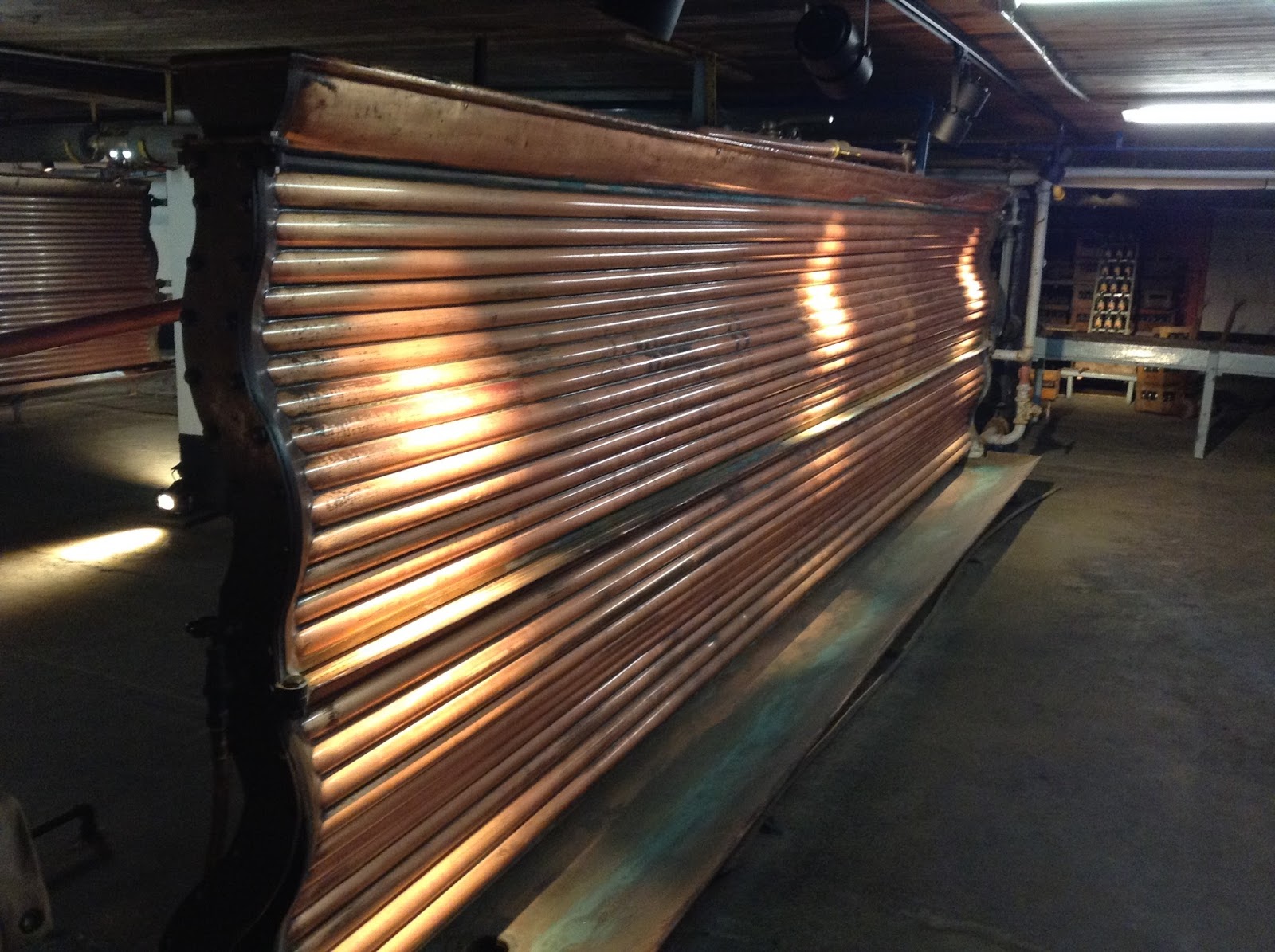
A Baudelot Chiller. This one, at Liefmans, is quite large.
Smaller ones (not necessarily in use) can be seen at De Dolle or a Vapeur.
Again, as with the other recipe, the cooling method is not specified. But Baudelot chillers or coolships would have been the norm. If you are unfamiliar with Baudelot chillers, the hot wort runs down the outside of a stack of pipes while cold water flows through the pipes, leaving the wort exposed to air as it is cooling. The wort is then collected in a trough at the bottom and sent to the fermenter(s). Both Baudelot chiller and coolships leave cooled wort open and exposed to air. Though there are obvious important differences in time here, a Baudelot chiller is still not an especially sterile way to cool wort.

Fermentation
Fewer details are given for the fermentation of this beer than the infusion recipe, but I suspect it followed something similar to the infusion recipe (pitching around 20° C / 68° F, primary fermentation in barrels or open tanks followed by aging in barrels, and either option with aging on the order of 5 months before serving). The article mentions the beer would be served in July or August.

Modern Homebrew Adaptation
Batch Size: 19 L (5 gal) pre-fermentation wort
OG: 1.050
ABV: ~6%
IBU (theoretical, Tinseth): 24
Total Efficiency: 75%

4.1 kg (9.0 lb) Continental European Pale Malt
-This could be swapped for a 6-row malt, though if so it might be better to select a malt without a super high enzyme potential. You may be able to source something from a local craft maltster like the following: Double Eagle (see their Rustic Ale)Skagit Valley Malting (look for something made from Alba barley), and Riverbend Malthouse (I've heard they make a malt form 6-row, but couldn't find any info about it on their website).


The Q&A from PJB 1905 regarding this recipe.
100 g (3.5 oz) Stisselspalt (2.0 % aa). Given the specific mention of Alsace hops I think this makes the most sense, but other landrace hops or perhaps some more modern French hops with a similar profile would work well. You could adjust hopping rates down if going with hops with higher alpha acid levels. See also the notes at the bottom regarding hops and how I have modified these from the original recipe (and maybe adjusted down the hopping rate too far). The more I think about it, the more I think I've over-adjusted. But I'll keep this at 100 to keep it consistent with the other recipe. In brief, the original recipe calls for ~125 g (4.4 oz) of hops, so do that if you want to follow the original recipe more closely.

Mash: As noted above, this is an approximation of the recipe based on some volume assumptions (no addition or turbid wort volumes are noted). I think this should work based on past turbid mashes I’ve conducted, but I haven’t had a chance to try this out. So let me know if you run into any odd problems and you think there is an error in these numbers. I’m erring a bit on the wet side for the mash. Especially when it comes to the second and third turbid portions. You could remove more turbid wort, making the mash drier, if you wished. Without conducting it first myself I feel I should err in this way. But I think a drier mash/pulling more turbid wort at later steps would more likely reflect what was historically done.

As is always a good idea when conducting a new mash schedule (especially a turbid mash) or changing your equipment, it is best to have extra cold and boiling water on hand to adjust the temps as needed. And also it is a good idea not to max out you equipment to allow room for any adjustments.
  1. Dough in by adding 4.1 kg (9.0 lb) malt to 8.5 L (9.0 qt) at 38.3° C (101° F). This should give you 2.1 L/kg (1.0 qt/lb) at 35° C (95° F). Rest 25 minutes. You could also add water to grain, but with a drier mash I find it easier to add grain to water.
  2. Take the first turbid pull. I am guessing this would be around 1.7 L (1.8 qt), leaving you with around 1.67 L/kg (0.8 qt/lb) remaining in the kettle. Start heating the turbid pull, being careful not to scorch it.
  3. Add 3.7 L (3.9 qt) boiling water to the mash to reach 2.57 L/kg (1.23 qt/lb) at 54° C (129° F). Rest 10 minutes.
  4. Take the second turbid pull. I’m guessing around 3.0 L (3.2 qt) would be about right, leaving you with 1.84 L/kg (0.88 qt/lb).
  5. Add 6.3 L (6.67 qt) water at 78.3° C (173° F) to reach 3.34 L/kg (1.6 qt/lb) at 64° C (147° F).
  6. Immediately after this new temperature is reached, take the final turbid pull. This should be around 4.26 L (4.5 qt), leaving you with roughly 2.3 L/kg (1.1 qt/lb) in the mash tun. Heat the turbid portion to boiling. Let the mash rest at 64° C (147° F) for another 40 minutes.
  7. Add back the turbid portion. By my calculations this should be around 8.8 L (9.3 qt) and about 85° C (185° F) is the right temperature to reach 73-74° C (163-165 F). This should give you a mash around 4.5 L/kg (2.15 qt/lb). Rest here for 45 minutes. This may require letting the turbid wort cool a bit before adding it, or mixing some cold water in.
  8. Lauter and sparge as normal. Sparge water was listed as 75° C (167° F).
A schematic of the mash schedule, adapted for a homebrew scale with assumptions regarding volumes.
Boil: If you want to stick with this recipe then you're doing an 8 hour boil. This is quite long and you could probably shorten it if you wanted. Especially if such a long boil wasn't necessary to hit your target numbers. This will change melanoidin formation, but I think going for 3-5 hours would probably be a reasonable compromise here. And of course you could still make a beer following these guidelines with a 60-90 minute boil, but there would be some differences. Split the hops between the start of the boil - 1/3 of the total hop dose, or 33 g (again this can be adjusted based on aa) - and 2/3 of the hops, or 67 g, with 30 minutes left in the boil. See the note at the end about hopping rates in these homebrew recipes.

(Edit 16-Mar: As brought up in this FB discussion, doing a full-strength boil for 8 hours on a homebrew system might not work out too well. It is possible that in the original commercial brewery this was a simmer, though at the time at least some breweries were doing full strength boils for this much time. But on a homebrew setup, a boil of this length may not result in the beer you would want due to over-concentration of the wort and associated darkening/fermentability changes. So especially as a homebrewer, there is a strong case to be made for shortening this boil. I might start with something around 4 hours, and adapt from there.)

Cool the wort as you prefer - open in a kettle/coolship or with some sort of chiller.

Fermentation: I would take the same approach to fermenting this beer as I suggested for the other saison recipe. So that would include pitching a mixed culture that you like with yeast and lactic acid bacteria. I’d aim for something that includes some more hop-tolerant bacteria if you can. And I personally prefer to do mixed primary fermentations with everything in there from the start. Age the beer for on the order of 6 months, perhaps a month or two longer, before packaging. And make sure that the FG is stable. Oak would probably be for the ideal fermentation vessel, or at least for aging, but glass or stainless would also work fine.

Comparison of the Infusion and Turbid Mash Recipes
To me much of the important substance of both recipes is the same - 100% winter 6 row barley, roughly 3 kg hops from the general region (Belgian or Northern French hops) per 100 kg grain, a long boil (>5 hours) and aging until late summer/early fall (so about 6-8 months from brew to serving the beer). Both recipes also include a fair amount of hops added later in the boil where they could be more flavor-active, even though the beer will be aged for a while. In my experience with beers for aging with noble hops or similar, this can hold up pretty well. So I expect hop flavor from these hops does carry through to the finished beer. The infusion recipe lists 40% with one hour left and the turbid mash includes 2/3 of the hops with only 30 minutes left. These 'late' hops will see a fair amount of boil, which may come as a surprise to people used to more of the modern N American brewing process, but there should still be a flavor impact with noble-type hops at these boil and aging times.

While the two recipes call for basically the same total hop load, the splitting and timing of additions creates some interesting distinction. The infusion recipe calls for 60% of the hops to be boiled for at least 5 hours, and the remaining 40% are boiled for an hour. Additionally, the infusion recipe mentions Bavarian hops for the last hour. It looks like I may have forgotten to include this in the infusion recipe post itself, and that post will be updated to include this. This could be a non-trivial point for flavor, bitterness and microbiological progression, so I'm sorry about that. Other sources at this time mention these hops are more antibacterial than Belgian hops. This may be due to varieties as well as growing conditions or general hop quality. So this hop origin choice combined with the timing of the addition and the split favoring longer boils in this recipe may lead to a more bitter and less acidic saison, when comparing the two recipes. Furthermore, in the recipe calculations I've used a lower aa hop which would suppress the calculated IBUs, resulting in a beer that, on paper, seems less bitter than it should have been (see below for more on this).

On the other hand, the turbid mash recipe calls for only 1/3 of the hops to be boiled for more than 30 minutes. This would strongly favor carrying hop flavor through compared to the infusion recipe. Consequently this beer would likely have been less bitter (as is reflected in the theoretical IBUs, as the TM recipe calculated to ~30% less bitter than the infusion recipe) and could lead to a beer with more acidity along with the hop flavor. This shows the spread of saison at the time (something Yvan de Baets notes in his history of saison chapter in Farmhouse Ales), that historic saisons would have prominent bitterness or acidity.

On the mash side, I think the nature of these two mashes illustrates the brewing mentality to these beers pretty well. There is definitely not one mash to brew saisons, and these two mashes have some strong differences in terms of process. But there are also some core details that are fairly similar, and which are similar to some saison mashes still conducted today (see this post, for example). Both mashes have a rest around 53° C (~130° F) and saccharification steps that, especially for modern saison, are quite high - both include saccharification steps at or above 71° C (~160° F).  Furthermore, these were not short saccharification rests, so they definitely served a purpose. But the differences between these two mashes highlights some variability in process: doing a low temperature soak of the grain or not, spending an extended time in protein rest temperatures or just a quick rest, one or two saccharification rests, etc. Finally, the saccharification temp difference between these mashes and modern saison could reflect some differences in the brewing and the nature of saison. If you were aging it for 6+ months with a mixed culture then perhaps maximizing fermentability to Saccharomyces c. wouldn't be as much of an issue.

Hop, bitterness and my (possibly flawed) adjustments
For both of these recipes, I have dropped the hopping rate down a bit in my homebrew adaptations. There are many complicating factors that could make my decision to drop this down better or worse. To be honest, I forgot I had done it until I was writing this second post. One of the main things I was thinking about was hop aa levels increasing over time, mostly based on varieties but also a bit on quality of hops. But I hadn't considered that the hopping rates are referenced to malt amounts, and grain has changed quite a bit as well such that less grain is needed now to get the same extract. This would act to reduce the hopping rate per volume, and would result in my calculation of hopping rates being artificially low, so my adjustment to further lower the hopping rates may have been flawed. This may be counteracted a bit by my homebrew-level total efficiency of 75%, which is lower than many commercial breweries. (Edit 27-Mar-18) I also didn't consider that efficiency of hop use drops on smaller scales as well, which may suggest that I was overly-cautious in scaling back the hops as I did for this homebrew recipe.

Anyway, I'll leave the rates in these recipes as 100 g, but I feel less confident in this now. As I haven't had a chance to brew these, I can't see if I think the resulting bitterness from what I've listed is reasonable. If you want to try to come closer to the exact rates in the text that would be about 125 g per 19 L batch, and please report back if you go with this rate. It should be easy to adjust as the recipe is based on percentages at different times. As I noted above, I'm feeling less solid about my choice to scale the hops back a bit, but I think there are arguments to be made for and against this and it is hard to balance them all out with the uncertainty in each. Whatever you chose to do, I wanted to let you know my thinking and the uncertainty that remains.

Regarding the hopping rates and bitterness, I want to note a few things. First, this should be taken as a rough estimate. I’ve simply chosen a low aa modern hop, and variability in this value would result in a fair amount of variability in bitterness in the beer. Finally, there are other components that would contribute to perceived bitterness than isomerized alpha acids (e.g. tannins and beta acids). And by taking a larger amount of low acid hops (possibly poorly stored hops by modern standards) and putting them through a prolonged boil, I think you are going to get a higher perceived bitterness than the same amount of total alpha acid from a high aa hop. So I’d expect these beers to appear a fair bit higher than 30-35 IBU. And finally, as noted above, I've dropped the hopping rates by about 20% from those presented in the original recipes.

So on the whole I would treat both of these beers as more bitter than the theoretical IBUs presented here would suggest. And I would caution anyone trying to hit the same IBUs here but with high aa hops and trying to come out with a beers that would be perceived similarly or trying to brew with more historical accuracy, as the use of lower rates of high aa hops would probably further soften the beers. And I think this would move the beers further from their original nature. If you want to brew with high alpha bittering additions that's fine, as long as you recognize that this would create a different beer less in line with the history. And of course, there's nothing wrong with that.

Monday, January 8, 2018

Bière de Saison (1905) recipe - infusion mash

Compared to other beers (like lambic, grisette and Bière de Garde), I haven't said much about historic saison on this blog. So it's probably time I do a bit of that. Two fairly complete recipes are given for "bières de saison" in the Q&A sections of the 1905 Petit Journal du Brasseur. In both cases, the brewer describes their process in detail and asks for advice on this proposed process to make these beers. One of brewers wants to brew by infusion and the other by a form of turbid mashing. On the whole the recipes have similarities but I think it is worth presenting both in full as the two give a good idea how brewers were approaching these beers at the time - both in their similarities and their differences.

Question about a bière de saison in PJB 1905.
In this first post I'll address the infusion recipe as well as some background/context, with the turbid mash recipe and some comparison saved for the second post.

Background
Though the breweries aren't named, from the publication and the text it is clear that these are somewhat industrial brewers rather than the rustic farmhouse notion of saison (in the same way that modern saison breweries are generally not really farmhouse breweries but industrial breweries, some of which happen to be around farms). In that sense though, I think these recipes show an important point in the history of saison. They come at a time when the beers were still brewed in the winter and served in the summer and were still mixed-culture beers, but also when the beer had moved to commercial breweries as a component of their production instead of the lore of an off-season brew at a farm. So in that way they offer a point of connection between modern saison and the origins of saison, and they may fall close, in spirit at least, to the modern mixed-culture saisons.

I feel like I should also say something about the use of the term bière de garde here (although I've also discussed this in other posts recently). Both brewers call the beers they want to make a bière de saison and then clarify in parentheses a bière de garde. Bière de garde is used in a general sense here to mean a beer for aging, with bière de saison being a bit more of a specific name, but this shows the fluidity of both of these names for Belgian beer at the time. With that said, the recipe, process and advice given for these beers is quite similar in many ways to the sort of considerations taken when making Bières de Garde from the north of France.

These recipes both use "Escourgeon". I've talked about this elsewhere and it shows up in other places such as the saison history chapter of Farmhouse Ales. If you are unfamiliar with this grain, it is winter 6-row barley. In the 1800s and early 1900s Belgium was growing and using 6-row barley more or less exclusively. Escourgeon is frequently the recommended barley for beers for aging, though it may have been harsher than spring 6-row barley in younger beers. Within Escourgeon there was also a hierarchy, with certain regions preferred over others. In general, Escourgeon would have had a higher protein content than modern grains. With proper malting and mashing, this would mean more darkening (and the sort of flavor development that goes along with this) in kilning and boiling.

One final general point about these recipes - neither one of these recipes discusses the flavor profile of the finished beer or if the fermentation was "pure culture". But, given the time and the nature of beer (ale fermentation), they were likely mixed culture beers. What exactly that means would have varied from brewery to brewery, but it likely included some atypical Saccharomyces strains or non-Saccharomyces yeasts (so possibly Brett and/or other yeasts that you might find in other Belgian mixed culture beers) as well as the potential for bacteria. Both beers are reasonably hopped - around or above modern lambic levels (though this is not really a good comparison as one case deals with fresh hops from 100+ years ago that may not grown anymore and the other deals with aged modern hops).

Open-topped mash tuns, like this one at
Brasserie à Vapeur, can lose a lot of heat.
It is possible that in the time scale of around 5 months, some bières de saison may not have developed a lot of acidity. But I would guess that many would have, given acidity in other comparable beers like Bière de Garde, other discussions in PJB about acidic saisons and PJB discussions about customer taste preferences. So, for the modern brewer looking to brew something based off of this, using a mixed culture with multiple yeasts as well as lactic acid bacteria would be a good way to go.

Recipe
OG: 1.049-1.051
100% Escourgeon Malt
Hops from Poperinge - 3.1 kg per 100 kg grain, ~450 g/HL wort pre-boil. The varietal is not specified. Hopping is discussed below in more detail.

Process
Mash
  1. Mix water at 60-62° C (140-143.6° F) with the grain reach 52-55° C (125.6-131° F) in the mash tun. Mix for 20 minutes and then rest for 10-15 minutes.
  2. Infuse with water at 90° C to boiling to raise the temperature to 70-71° C (158-159.8° F). Rest 1.5 hours.
  3. Collect wort from the initial saccharification rest into the boil kettle.
  4. Infuse with water at 76-85° C (168.8-185° F) such that the mash temperature remains at 70-72° C (158-161.6° F). Mix for 20 minutes and then rest for 30 minutes.
  5. Collect wort from the second saccharification rest into the boil kettle.
  6. Sparge with water at around 75° C (167° F), or perhaps slightly warmer.
The old Brasserie Dupont mash tun.
There are some general things to keep in mind with this info regarding the temperatures of the added water and the resulting mash temperatures. A typical mash tun of the time would have been an open-topped iron mash tun with an aspect ratio sort of like a hockey puck or tuna can rather than something with closer to a 1:1 width to height ratio or more like a soup can (as is more typical of modern equipment). These ~1900 Belgian mash tuns could have lost a good deal of heat over the course of a mash rest (possibly around 2° C / 3.6° F per 30 minutes as mentioned in this post). Additionally, the infusion water is heating both the grain and the thick iron mash tun, and the latter would take a lot of heat to warm it up compared to modern equipment. Therefore, attempting to mash like this on a home scale or with modern commercial equipment might require some adjustments of the infusion water (smaller volumes or cooler water).

Hop fields in Poperinge.
Boil and hopping
The boil lasted 5 hours. The hopping was as follows:
  • First wort hopping:
    • 10% of the hops after the first mash runnings were collected
    • 10% of the hops when all of the wort has been collected but before the boil starts
  • Hops in the boil
    • 40% of the hops after boiling for one hour
    • 40% of the hops one hour before the boil ends (or 4 hours into the boil)
As noted above, the hops used in this recipe came from the Poperinge region, one of the two main regions of historic Belgian hop growing (and the main region for modern-day Belgian hop growing). The landrace Belgian varieties grown at this time (e.g. Coigneau, Buvrinnes / Tige Vert / Duitsche Hop / Tige Allemande, Groene Bel / Cloche Vert, Tige Blanche / Witte Ranke, Tige Rouge / Roode Rank) have more or less disappeared, though some varieties have been re-discovered and are seeing small-scale cultivation starting up.

Belgian hops were believed to be a bit less potent than contemporaneous German and Czech hops (for a bit more info comparing hops from different regions in the late 1800s and early 1900s, see the table in this blog post), and it is also likely that advances in hop farming could result in higher alpha acids in modern hops than historic hops. For the modern brewer, landrace French hops may be a good choice, or German or Czech hops at a slightly lower hopping rate than the one quoted here.

The final volume isn't noted in the Q&A so I'm not sure exactly what the final hopping rate would be in terms of g per HL. Based on the pre-boil volume given (45 HL) and the process (5 hour boil, maybe cooling in coolships or maybe not), and similar modern breweries (lambic brewing) I'm going to estimate that this is roughly 530 to 630 g per HL of wort in the fermenter, depending on if a coolship is used or the wort is force-cooled.

The old (and long out of use) coolship at Brasserie à Vapeur.
Fermentation and aging
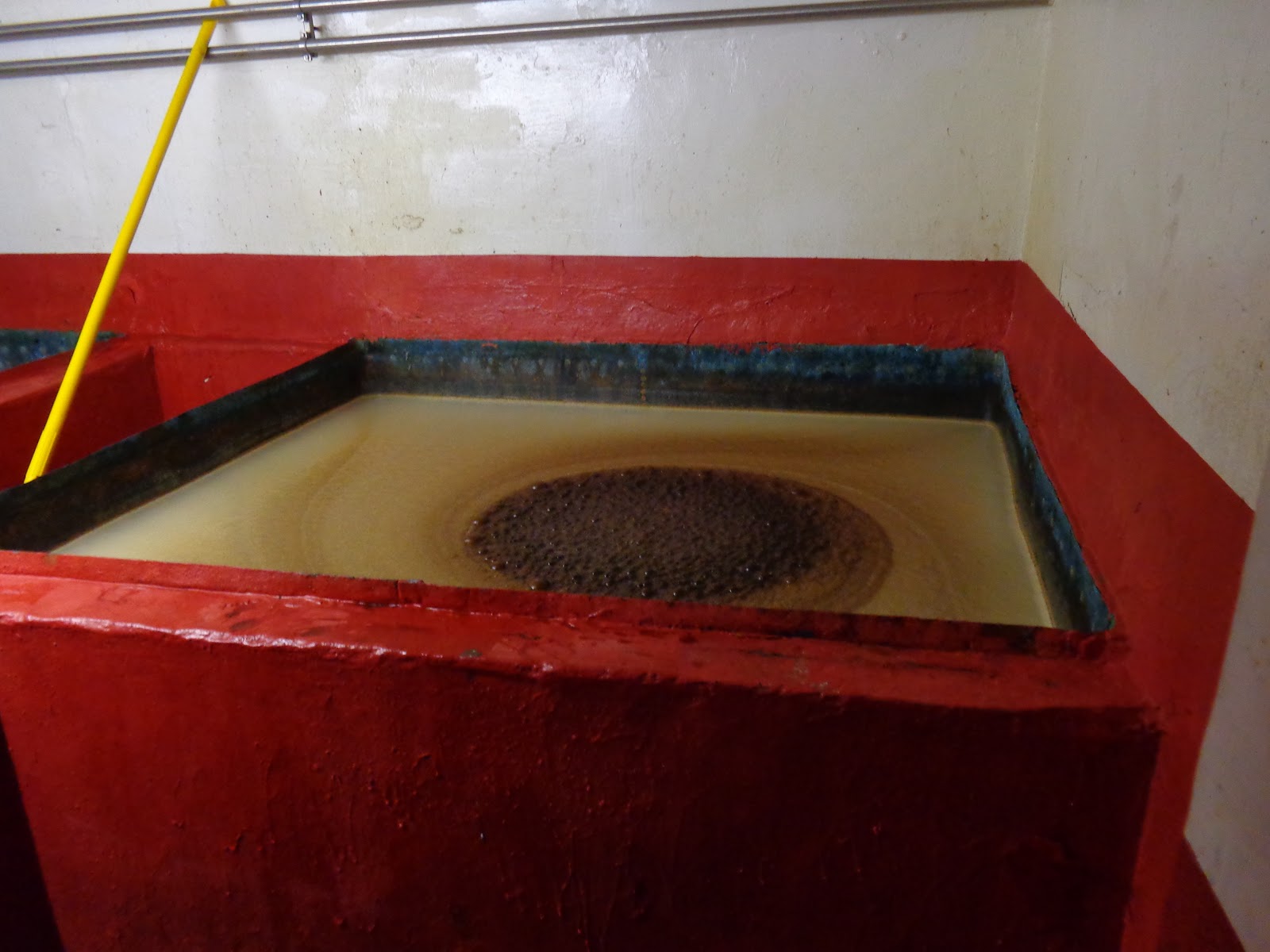
Yeast was pitched when the beer was 21° C / 70° F (nothing is said about the method of cooling, but coolships or a cooling system like a Baudelot chiller would have been appropriate). It sounds like fermentation at this specific brewery took place in a metal tank - perhaps something like what is shown below. But the beer was then aged for around 5 months, likely in wooden barrels.

Modern homebrew adaptation
Here is an approximation for adapting this to modern ingredients and at homebrew sizes. Feel free to make your own adaptations from the historic recipe. I haven't yet tried to brew something like this myself, so this is a theoretical recipe and could have some kinks to work out.

Batch size: 19 L (5 gal) pre-fermentation wort
OG: 1.050
ABV: ~6%
IBU (theoretical, Tinseth): 35
Total Efficiency: 75%

Open fermentation in a metal tank at De Dolle.
4.1 kg (9.0 lb) Continental European Pale malt. Go for something like Dingemans, Chateau, or Soufflet/Franco-Belges if you want a bit more color or something like Weyermann and Best is you want it to be a bit paler.

100 g Strisselspalt, 2% aa (other another low aa landrace hop, you may want to adjust the 4 hr boil addition a bit based on aa if you swap to another hop)

Mash: This follows the mash above, but you should probably rerun the infusion temperature and volume calculations as this could vary a bit based on your system. Keeping extra boiling water and extra cold water on hand in case you need to quickly adjust the mash temperature is probably good too. I think this is good in general, especially with new or complicated/strange mash schedules.
  1. Mix grain with 7.7 L of water at 60.6° C (8.1 qt at 141° F) to reach 53° C (127.4° F). 10 minutes total for adding the water and mixing. Rest for 20 minutes.
  2. Slowly infuse 8.1 L of water at 89° C (8.6 qt at 192.3° F) to reach a mash temperature of 70° C (158° F). Take 10-20 minutes for the rise, so maybe add the volume in small steps rather than all at once. Rest for 1.5 hours. This step could probably be shortened a bit with modern conditions.
  3. Drain the mash into the boil kettle. Keep this wort on low heat (intermittently if necessary) so that it stays between 75° C and boiling. I'm guessing the volume in the boil kettle should be around 12.4 L (3.25 gal) based on a grain absorption of around 4.2 L (~1.1 gal) and with a bit of extra wort remaining behind from false bottom dead space, etc. The remaining calculations are based on this figure.
  4. Infuse with 15.5 L at 71.7° C (16.4 qt at 161° F). The total time for the addition and mixing should be around 10 minutes. The rest for 30 minutes. This step could also probably be shortened with modern grain/equipment.
  5. Drain the wort and sparge (fly or batch, as you prefer) with water at 75° C (167° F).
Boil: 5 hour boil. For me that would mean starting with about 42.6 L (11.25 gal) assuming 3.8 L (1 gal) per hour boil off and 3.8 L (1 gal) loss to trub. Begin heating to a boil after the second mash wort is collected or, if fly sparging, shortly after you begin sparging.
  • First wort hop: 20 g, split evenly between hops added after the first wort is collected and once the wort from the second mash is collected.
  • 40 g hops after 1 hour of boiling.
  • 40 g of hops after 4 hours of boiling / with 1 hour left in the boil.
Either chill by using your boil kettle as a coolship or as you would normally chill your wort. If you go the coolship route this will likely change the extraction from the hops. If you have another kettle/vessel to use as a coolship then you could transfer off the hops into that when you begin cooling.

Fermentation: Pitch a mixed culture that you like including multiple yeasts and bacteria. I tend to keep around dregs of various commercial beers that I like along with a saison strain and some brett isolates/blends, so I'd probably use a combination of these (e.g. a saison strain or two that I like co-pitched with a brett isolate or brett blend that I like along with the dregs of commercial barrel aged saisons and/or lambics that I like all together for primary). Pitch the yeast around 20° C (68° F) and let free rise, or possible help it rise. The exact profile you follow will depend on which saison strains you choose.

Age for about 5-6 months, or until gravity is stable and you like the character. I see no reason to rack to a new vessel for the aging, so I'd just leave it in the primary fermenter if your primary is fairly air-tight (glass or stainless). Wood would also be fine if you have a good barrel, though I'd lean toward larger barrels if you go this route. I know small  barrels can work out well for some, but I've tasted a lot more disappointing beers from small barrels (too much oak/barrel character or too much O2) than good ones. Then bottle (or keg, if that's your preference - I'm partial to bottling), keeping in mind final gravity stability to avoid over-carbonation problems.

Part 2 of this, with a turbid-mashed saison recipe, is now up. You can find it here.

Monday, December 18, 2017

Brief Translations Compiled

From time to time I'll put some of the quick translation work that I'm doing on the blog's FB page. These are usually snippets of articles/books or quick Q&A sections from Petit Journal du Brasseur. I feel that these posts don't warrant their own full blog post (at least not at this stage), but I still find them interesting so I want to share them somewhere. The downside of doing this on FB is that they are quickly lost and tricky to retrieve. So I've decided to catalog them here in this blog post so that anyone (myself included) can easily find them and look back at them.

A question about brewing a beer for aging (PJB 1910).
Some new old brewing information:
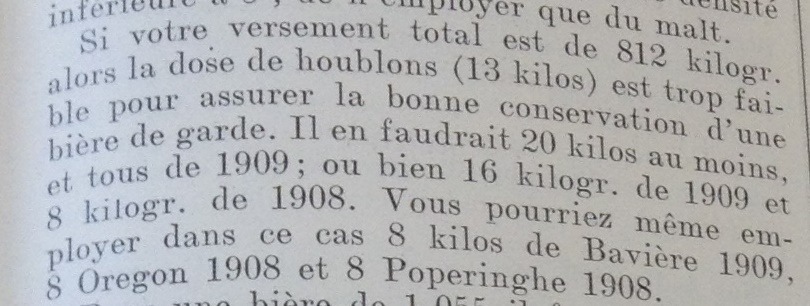
In addition, I thought I should add something new, so here's a new snippet of something quick - the sort of thing that I'd usually put on the FB page. This comes from Petit Journal du Brasseur in 1910, where a brewer is asking about brewing a bière de garde with an OG of 1.055 for serving in summer (note that bière de garde is used here as a general term for an aged beer, not for the French category Bière de Garde). The advice follows general advice for this sort of beer for the time (for example, suggesting 100% barley malt, though as the gravity is above 1.050 perhaps some unmalted grain could be used) but with some good insight.

I think the discussion of hopping is a good section to highlight here as there are a couple important points. First, they note hopping rates need to be sufficiently high for the beer and suggest at least 20 kg for 812 kg of grain. This hopping rate is pretty high (on the order of 50% higher than lambic at some modern breweries). Unfortunately the batch size isn't given, but making efficiency assumptions based on other beers of the time, this is probably roughly a hopping rate of 500 g/HL (an earlier version mistakenly said 500g/L, see the hopping table in this post for notes on conversion factors here). This highlights the importance that brewers of the time placed on hopping beers for aging at elevated rates.

Second, there is discussion of using hops of multiple years. So potentially a brewer could be using aged hops in their beer, but the volume of aged hops suggested would be roughly doubled to replace a portion of hops from the most recent harvest. I like the information here regarding aged hops v. fresh for hopping rates as well as the context that the information gives - brewers may or may not be using aged hops for beers destined for aging that weren't lambic. Finally, the post discusses the possibility of using hops from Oregon. The use of US hops shows up elsewhere at this time in Belgium but I don't think I've talked about it before. So this is a good time to point out that US hops were used by some brewers in Belgium in the early 1900s.

Mention of hopping rates, age and origin (PJB 1910).

Links to the previous FB posts:
Here is a compiled list of posts from the blog's FB page. This is organized by topic, with the original source and posting date, and any other notes. I'll try to remember to update it as I post more on the FB page.

Lambic, Faro, Bière de Mars, Geuze:
Saison and Belgian bière de garde:
(As noted above, there bière de garde can mean different things. The differentiation of the Francophone Belgian use of the term bière de garde and this term used to describe distinct beers from the North of France is discussed a bit more in this blog post)
Other:

Monday, November 20, 2017

Brewing Bières de Garde (1850-1910)

Following up on this blog post giving background info on Bière de Garde and French brewing around 1900, this post gets into the brewing side of historic Bière de Garde. As noted in the background post, these beers are distinct from the modern northern French beers of the same name. As a brief comment on the modern side, I learned recently from Daniel Thiriez of Brasserie Thiriez that there is a new (well, ~1 year old) French law regarding what can be called a Bière de Garde - the beers now must be aged a minimum of 21 days after primary. We agreed that this law seems to be a bit toothless and quite broad, as there is no recipe restriction, etc. And 21 days is a far cry from the 6+ months of aging for Bière de Garde from around 1900.

Bière de Garde advertisement from the early 1900s.
From the collection of D. Thiriez.
The information for this post is a synthesis of 9 texts from 1850 to the early 1900s. These texts present a view from more established breweries, and spanning the time from the height of Bière de Garde to near when the original long-aged mixed culture versions disappeared. While each of the texts has small differences from the others, the general nature of the beer remains the same - a roughly amber colored beer of mixed fermentation with a moderate hopping and which is allowed to become acidic and vinous over 6+ months of aging.

Ingredients:
The grist composition of Bière de Garde was 100% malted barley which, for the time, was kilned using older methods. Direct heat was used and that the malt came out slightly toward amber. I think something along the lines of a continental European Pale Ale malt is about right given the descriptions of the final beer color and the process. The recommended barley was the Escourgeon, or winter 6-row barley. This was the common grain for much the area (across Belgium you often see the same recommendation) and it could be a bit of a sharp or coarse malt. Escourgeon had more polyphenols and higher nitrogen levels, which would help to develop more melanoidin compounds in kilning and boiling. This sort of malt wasn't great for softer or quicker turnaround beers, but it was well suited for aged beers.

Hops for Bière de Garde were primarily coming from the Nord region or Belgium. These hops were of more standard quality. This may present a bit of a challenge to the modern brewer, but French landrace hops may be a good place to start. Some sources also mention a portion of higher quality hops coming from Bavaria, Bohemia, or other regions of France, so this gives modern brewers some more options.

Yeast was pitched for Bière de Garde, and based on the descriptions of the final beers it was a mixed culture involving at least Brettanomyces and lactic acid bacteria in addition to Saccharomyces. Figuier, quoting Müller (1873), notes that Bière de Garde, and in general the beers of this region, had a vinous quality and that this quality was sought by locals.

General Specifications
Bière de Garde is described as an golden-amber or brown beer (sometimes both by the same source, suggesting that "brown" may have been used more generally or encompassed a wider range than it does now). Either way, from this I suspect the beers were generally not toward the darker side of brown, and a pale amber may be a better description for the modern brewer/beer drinker. The paler side of amber seems to fit better with the above photo. Though I'll note that the original of that print was from 1930, and therefore after Bière de Garde as discussed here had mostly (if not fully) vanished.

This table (below), modified slightly from a similar one posted a couple weeks ago on the blog's FB page, shows the parameters of ~1900 Bière de Garde alongside 1970s & modern lambic and geuze as well as modern Flanders acidic ales. Taking these 5 examples of Bière de Garde, the OG that one could expect around 1900 was roughly 1.045. This sounds a little low to me, so I wouldn't be surprised if gravities that were a bit higher (~1.050-1.055) were also brewed. But I haven't seen other gravities listed so far. With a very high attenuation, the alcohol of these examples generally comes out to around 6% ABV.

The acidity of the beers was fairly high, both in lactic and acetic acidity. On the whole the acid profiles compare well with Flanders acidic ales before they are blended back with younger beer for packaging, though BdG was a bit lower in lactic acid than these Flanders beers. And the acidity also compares well with more sharp lambics, but when averaging across multiple producers from the 1970s, ~1900 BdG is higher in both lactic and acetic acid.

A comparison of ~1900 Bière de Garde with some modern aged acidic beers.

Brewing Process
Mashing: Bière de Garde used a type of turbid mashing. Although only a few turbid mash schedules are known today, and only for a small range of beers, different schedules of turbid mashing were employed for a wide range of beers in Belgium and northern France. And there were many more versions of turbid mashing than remain in modern brewing (though even today there are still differences among lambic brewers about the specific rests, number of turbid pulls, and when the turbid wort is added back). The different Bière de Garde texts that I've seen all more or less describe the same sort of mash, with 3 temperature rests and one turbid pull:

-An initial infusion is conducted. Some texts have this rest temperature quite cool (25-35 C, some even lower than this) and others have it higher, in the protein conversion range.
-After the first rest, the wort is drained off and heated to a boil in a secondary boil kettle. This is the one turbid pull used in Bière de Garde mashing.
-Hot water (somewhere from 80 C to boiling) is added back to the grain bed to raise the temperature to the cooler end of the saccharification range. The mash rests here for a while.
-Wort is extracted and transferred to the primary boil kettle. Now the turbid wort which has been boiled comes back to the grain, and an additional saccharification step is now carried out with this wort.
-After the second saccharification this wort is combined with the earlier mash runnings in the primary boil kettle.
-The grain bed is sparged, more or less as normal, though much of this wort is used for table beers rather than Bière de Garde.

Here are a couple mash schemes from historic texts. First is a scheme based on the information in Bauby & Fournier (1868), taking into account the mashing that Bauby & Fournier report, the modifications they suggest, and filling in some gaps with reasoning and similar general schemes described by other sources. The second is a reproduction of the mashing scheme I presented in this blog post, which originally comes from Evans (1905). A couple of sources I looked at have the initial rest closer to 50 C rather than the cool starts of both of these mashes. But otherwise these other mashes follow a similar remaining process to these two. Finally, for reading the figures below, blue arrows represent transfer of liquid (removal of turbid wort, infusions, collecting final wort).

A mashing scheme based off of Bauby & Fournier (1868).
There are a couple general things to keep in mind with these mashing schemes. First, these mashes reflect non-modern conditions. Rest times could probably be shortened a bit if you wanted to try these yourself. Also, with the sort of equipment used in these breweries at this time, there was a much larger heat loss to the vessels than with modern equipment when raising the mash temperature. Additionally, it would not be uncommon to have an open topped mash tun, which would also lose a good deal of heat. Jean-Louis Dits of Brasserie à Vapeur has such a mash tun, and he reported temperature drops of up to 2 C per 30 minutes (see this post for more info about their mashing). So if you want to try one of these mashes yourself, you may want to lower the infusion temps to hit your targets and keep extra cold water around in case you overshoot. Finally, not everything is specified with these mashes to the extent that I would like (especially in the mash based on Bauby & Fournier). I have tried to fill in the gaps with what is reasonable given the mash process up to that point, expected heat loss, and what the wort would need to be like. And I have tried to present the remaining uncertainty to these assumptions.

The mashing scheme presented in Evans (1905).

Boiling: Bière de Garde underwent a long boiling. The sources agree on at least a 5 hour boil, with many mentioning boils lasting up to 8-10 hours. Considering this, the gravity is fairly moderate at around 1.040-1.050. The English brewers discussing the boil in Evans (1905) also note that they were surprised that the boil did not darken the beers as much as they expected.

Hopping rates were around 4-5 g/L (0.53-0.67 oz/gal), with some sources mentioning rates slightly above and below this. Some sources say that hops were added right at the start of the boil while others say hops were "only" boiled for a couple hours. So either way hops underwent a long boil of multiple hours. Some hops, especially if higher quality hops were used, may have been reserved for later in the boil. But overall this isn't discussed much in these texts

At the end of the boil the beers were cooled in coolships.

Fermentation: As noted above, Bière de Garde was pitched with a mixed culture, though at a lower rate than would have been common for most beers at the time. Fermentation began somewhere from around 20-25 C. Some later sources note the temperature may have started a bit cooler (~17-21 C). The beers were fermented in casks, generally the same casks as used for transport, and active fermentation took around 3 days. Following the primary fermentation, the beers were aged for around 6 months or more, during which time the beers developed acidity and vinous character.

Closing thoughts:
Having discussed BdG recipe and process, I think it is noteworthy that the descriptions of French Bière de Garde are quite similar to the descriptions of Saison in Belgian sources from around the same time. Suggested malts, mashing process, hops, boiling time, etc. are in general basically the same for these two beers. This is not surprising given that the Nord department borders the Hainaut province and that the beers share similar origin lore, but I think it is worth pointing out anyway.

Something to think of when
considering historic Bière de Garde?
Finally, I think it may be helpful to contextualize historic Bière de Garde by considering Cantillon's Iris. Perhaps this is a bit of a tired reference. When considering the above BdG-Saison comparison, I know I frequently say something to this effect and it is also in the De Baets chapter on Saison history in Farmhouse Ales. But I think the similarities are sufficient to bring it up again. Both are 100% malted barley (even more so - malt of about the right color) and also turbid mashed. The hopping rates are similar (though BdG was hopped a bit more and Iris is dry hopped). They both have a long boil and then are cooled in a coolship. Of course there are the important differences that Iris is spontaneously fermented while BdG was pitched with a mixed culture, Iris uses some aged hops, and Iris is aged longer. But still I think Iris probably falls closer to ~1900 BdG than many other modern beers would.

This wraps up a historic Bière de Garde brewday. Hopefully you found that informative, and it helped to differentiate the modern and historic (1850-1910) beers using this name. Here are links to other posts on the blog discussing Bière de Garde, both of which are also linked in the text above:

-Thoughts on Evans, 1905
-Introductory thoughts on BdG


Sources:
Lacambre (1851). Traité Complet de le Fabrication des Bières...
Bauby & Fournier (1868). Guide Raisonné de la Fabrication de la Bière.
Figuier (sometime in the 1870s, I'm not sure of the exact date). Les Merveilles de l'Industrtie...
Cartuyvels & Stammer (1879). Traité Complet Théorique et Pratique de le Fabrication de la Bière et du Malt
Boulin (1889). Manuel Pratique de la Fabrication de la Bière.
Moreau & Levy (1905). Traité Complet de le Fabrication des Bières...
Evans (1905). The Beers and Brewing Systems of Northern France.
Petit Journal du Brasseur (1910).
Mulo (I don't know the year). Brasseur ou Art de Faire Toutes Sortes de Bières.
Thanks also to Daniel Thiriez and Yvan De Baets for conversations that helped with organizing my thoughts about these beers.