Thursday, October 15, 2015

Grisette Recipe

July 2017 edit: I made this post in 2015 and I've learned a lot about grisette since then. I think this is a fine recipe for a good beer that is similar to grisette, but I think you could make a more 'grisette-y' grisette by following another recipe. For an updated and more grisette-like recipe, please see: What is Grisette part II.

This is a follow up to my What is Grisette post with a recipe for a beer that I felt was a grisette. In June 2015 I gave a talk about saisons at a local brewery and I wanted to talk a bit about grisette (prompted by some of the same factors that influenced the first grisette post). And I felt that if I was going to make claims about what I thought grisette was, and that it was different than what people may have previously tasted, then I had better show up with what I thought grisette was. In order to be able to serve it, I brewed this as a 'pilot batch' for a local brewery. But my continued involvement with this brewery will be focused elsewhere and I don't intend this grisette to go into any sort of one-off, seasonal or normal production in Victoria. So I don't think it will be going anywhere commercially for now, but that's not a reflection of what I think about the recipe. I intend to keep brewing something like this on a regular basis at home.

I brewed this before I did much of the research that went into the grisette post. I said in that post that at the time I was calling this beer a grisette, and I stand by that now. But there are probably some parts about this recipe that might not make for the most traditional grisette recipe. First and foremost is the hopping. This is fairly typical of my approach to hopping saison-oriented beers but it is probably inconsistent with what would have been done historically. My approach to hopping these beers is more influenced by the 'heavy on the late hops' sort of approach found in many North American hoppy beers. But I've been really happy with how this sort of hopping using noble-type hop varieties translates to saison-oriented beers. So to me a 'bittering addition' in most of my beers is probably either a first wort hopping or something more like an old school IPA flavor addition of roughly 45-30 minutes left in the boil. - Sidenote, so far I've felt that translating this sort of hopping to fruitier varieties (like southern hemisphere hops) doesn't quite produce the perceived bitterness that I would like, but that's a work in progress...

The second reason that this might not be a classic grisette recipe is the use of flaked oats. I have no reason to say that this was (or was not) employed in historic grisettes. But with such a low OG beer and highly attenuative yeast, I think it is a reasonable addition to build some body into the final beer while staying lighter with the grist. At a comparable time, wit beers would have been using oats (and to some grisette is described as a type of 'biere blanche', though that likely refers to the use of wheat and pale color rather than any other similarities to witbier) so it is not unheard of for Belgian brewers to be using oats at the time. And maybe oats made it into some grisettes, but I currently have no information to substantiate that so for now I'll treat the inclusion of oats as atypical.

So I stand by calling this a grisette, at least based on the 1900's characteristics that formed the basis of my analysis in the "What is Grisette" post. Unfortunately I don't have any of this left, so I can't sit down and write up some notes. But I did drink a reasonable amount of it. At first (before packaging) I thought it was perhaps too hoppy, but in the end I really liked it. It was crisp, light (quite light actually, perhaps a bit too much so) and had a pleasant hoppyness and bitterness to it. At first I thought it was too bitter, but that passed and I was happy with the level of bitterness. The head retention and appearance were nice - lightly hazy but not obtrusively so. Definitely a beer I would happily drink a lot of. I'll have to re-brew this and come up with detailed notes to know exactly how I'd like to change it, but probably the only thing I'd do at this point is shoot for a touch more malt presence, perhaps by slightly increasing the vienna portion.

The Grisette


Recipe

Brew day: 4-Apr-2015
Batch Size: ~ 12.5 gals (47.5 L) in primary
OG: 1.033
IBU: ~33 (Tinseth)
Transferring wort into my primary fermenter.
FG: 1.001
ABV: 4.2%
Bottled: 12-May-2015

Grist:
71.3% Doehnel #30 Pils malt
13.6% Wheat malt (1/2 CMC, half Weyermann)
6.8% Flaked oats
5.4% Vienna malt (Best)
2.9% Acidulated malt (Weyermann)
-I should note that this acidulated is for a minor pH adjustment and I think the recipe would probably work quite well (and possibly better) without it.

Hops:
40g Slovenain Aurora pellets, 8.0% aa at 45 min left in boil (~17 IBU)
34.5g Hallertauer Tradition pellets, 6.7% aa at 50 min left in boil (~10 IBU)
70g Czech Saaz whole hops, 3.1% aa at flame out, 25 minute whirlpool (~4 IBU)
31g Tettnang pellets, 4.4% aa at flame out, 25 minute whirlpool (~2 IBU)

Yeast:
A blend of Wyeast 3724 (Belgian Saison) and 3711 (French Saison), roughly 75%/25% respectively.

Other:
1 tab whirlfloc
6g Wyeast yeast nutrients
Water: +~95 ppm Ca2+, +~147 ppm SO42-, +~55 ppm Cl- to water that is basically equivalent to distilled to start

Mash: One step at about 151-152 F (66.1-66.7 C) for an hour. This didn't really result in a higher FG than mashing for fermentability, and sort of backs up my experience with 3711. I've always equated this yeast to brett in some ways as I felt that it kept working on more dextrinous stuff, both in the carboy and in the bottle (even when bottling at/below 1.000). And while everybody mentions crazy attenuation with this yeast I hadn't heard much about continued slow attenuation of 'non-fermentable' material after reaching 'FG' until hearing a couple pro brewers talking about it recently. So, in the same way as I'd treat brett, I probably won't go back to mashing higher to try to decrease attenuation with 3711 in the future, and instead will come up with other ways to increase the malt character and body.

Fermentation:
My pressurized racking cane.
This beer was fermented in a de-speared sanke keg. For this batch I just shoved a #11 bung into the top, but that forms a slightly imperfect seal (airlock still bubbles normally and I pressure racked out of it fine). So a bit more O2 may have gotten into the beer than ideal, but the beer was consumed pretty quickly and I didn't notice any issues from O2. It probably helped that I was using noble-type hops. I've since gathered the necessary supplies to adapt the de-speared keg and eliminate this potential for O2 pickup (a tri-clamp gasket that is flat on one side, a short tri-clamp stem and a clamp, see this Milk the Funk wiki page for some ideas).

Because this beer fermented at the brewery instead of at my house in conditions that I know how to control well, the temperature regulation wasn't everything I would have hoped for. But overall it worked out pretty well. The yeast was pitched around 68 F (20 C) and the beer was allowed to free rise/was raised to about 78 F (25.6 C) by day 4. The temp was held in the high 70s (~25 C) for about 10 days or so, and then it dropped to ambient for about 3 weeks. It was then cold crashed for a couple days and bottled/kegged. I used this cane to bottle/keg it (at right), but in the future I'd probably use another racking cane (as described by this Milk The Funk thread, thanks to my friend Shawn for construction help) for that purpose due to the easier ability to adjust cane depth in the fermenter (especially since I could't see where the yeast cake was).

As my research on grisette in ongoing, I'll periodically publish other posts on grisette (which might influence how I'd change brewing one in the future). I'll compile those here:

Hopping Historic Grisettes
Categories of Grisette and Grisette Strength
What is Grisette part II (including an updated recipe)

Wednesday, October 7, 2015

What is Grisette?


(edit Oct 2016: I expand upon and update this post in What is Grisette part II)

This post, which was some time in the making, was prompted by beer naming. This is a very difficult task for many brewers and I don't want to overplay issues in beer labeling or call any specific people out for poor labeling, but I do think that brewers should be thinking about appropriate labels and why that label is applied to a given beer. Labeling terms and beer styles have mutually agreed upon meanings and this is why they are valuable. But when those words are used to describe things outside of the scope of their mutually agreed upon meanings (or when brewers and/or consumers don't know the meanings of the words) then they loose their value. I'll save most of the philosophy and semantics discussion for a potential later post, but in brief, this need for integrity in the terms applied to beers was really brought home to me this past March when, on the same day, two different breweries close to me released a beer that they were calling a Grisette. Grisette seems to be one of the new buzzwords sweeping Belgian-inspired craft beer. It's like the new cool lost and obscure style. While I think grisette is a cool style and I want to see lots of good examples of it brewed, seeing beers popping up with the name grisette can be concerning because not many people have a good idea of what it should mean (both brewers and consumers included). And this is for a good reason - there is very little information out there about it! So consumers might learn grisette to be something that actually shouldn't be represented by the name, but that's all they've seen with the name so that's what they know. These local "grisettes" were, to my knowledge, the first two "grisettes" released in my area. And I didn't think either of these were very Grisette-y. So that got me thinking:

What is Grisette? What does it mean to me? Is that an accurate meaning? What else could it mean?

Grisette Grenier - note the industrial-themed background

After going back and looking through the available information I knew of on Grisette (there's not much), I started a couple discussions with other brewers and beer drinkers who think about these styles (one on the Milk the Funk facebook page and another on the Saison, BdG, Farmhouse appreciation society facebook page, I think you'll have to be a member of those pages to see the discussion). I got some good insight from other brewers and compiling that with the published information I knew about and some reasoned conjecture, here's my take on Grisettes with some historical context:

While Saisons are (historically) beers rooted in the farm, Grisettes are beers inherently rooted in industry and the industrial revolution. They were brewed for miners in the Hainaut province (and possibly adjacent mining areas) in south of Belgium, which until the World Wars was one of the centers of the Industrial Revolution in Europe (see this wikipedia page and the cities mentioned within). The Hainaut province is the same region that saisons come from, and there were likely significant similarities between the two beers. Both mining and farming are rural activities done on (or in) the land with the need for an urban area nearby to sell/process goods and for trading. And in addition both the styles are beers to refresh the workers and, as such, would have been lower strength and would have fulfilled the same basic requirements.

As the world industrialized as a whole, so did breweries. And this would have influenced beers (which influences grisettes as well as saisons). This means larger breweries with better/more specialized equipment and more desire for consistency. And more specific roles and trained people to work those roles rather than brewing being a part time task in the off season. For beer, and especially grisette as it would have been more central in industrialization than saison, this would mean beers trending toward cleaner fermentation and the regular use of certain ingredients rather than more variable recipes. It also might mean that with brewing more as an occupation and less as a role secondary to another occupation such as farming, the amount of time given to each beer for fermentation and conditioning would start to come down, resulting in 'cleaner' beer (by this I mean less influence of slower growing wild yeasts and bacteria and not a reflection on Saccharomyces yeast character, which is often developed and complex for strains common in saison) whether or not 'cleaner' pitches of yeast were used for fermentation. And beers being sold sooner would also lead to brewers wanting to produce beers that were ready to be released sooner.

Malting practices were becoming better at the same time, meaning more consistent and also likely paler malts were available. Consumer taste preferences were starting to shift as beers traveled further and imported beers came in. All of this combines to yield a very dynamic landscape for beer. And as writers of the time still for the most part didn't care about smaller styles of beer being brewed in these rural (though sometimes not so rural) areas of Belgium, there isn't a lot of sound documentation on what was going on.

Some breweries would make both saisons and grisettes in addition to many other beers (see these label collections from Brasserie Bavery and Brasserie Fauconnier for example). It is likely that with the dynamic beer landscape of the time, these styles would have drifted both on their own and in relation to each other. What we know about grisettes from historical records is often contradictory. This could be because authors may be discussing grisettes from different time periods and/or different producers. Beer styles definitely changed over time and grisettes were around long enough to see some of that change. This caveat should be kept in mind for the rest of this discussion, as much of the grisette info I'll reference comes from the 1900s. So perhaps grisette would have been different in the mid 1800s. Differences in historical information could also be because the information at the time was not always accurate/representative and objective or something might be lost in translating outdated/seldom used terms and units of measure. Whatever the case, here's what we've got-

From Farmhouse Ales by Markowski, pp.131-133:

  • No longer produced but used to be fairly common
  • Modern beers in Belgium called grisette are not like historic grisette
  • low abv (~3-5%)
  • light bodied, dry and refreshing
  • saison-like, but with hops giving all of the refreshing quality rather than acidity as well as hops as was possible in old saisons
  • golden in color, clean blond ales
but also
  • OG of 16.3-17.5
  • Amber in color
From Brewing with Wheat by Stan Hieronymus (p.xi, 23):
  • Modern beers called grisette in Belgium are not like historic grisette
  • Disappeared around 1960 (coincidentally around the same time as the major downturn of industry and the subsequent economic downturn of the region)
  • Included malted wheat, around 10% of the grist
  • The wheat was kilned at a very low temperature
  • Grisette was brewed with relatively modern (for the time) brewing techniques
  • Ranged in color from white to brown
  • three strength classes
    • Jeune/young: brewed all year, summer version 'stronger' at 10.2-11 P (1.043-1.046)
    • de garde/de saison: brewed in the winter, 12 P and up (1.048+)
    • Supérior/double: stronger, used first 2 runnings from mash (rest went to a small beer)
  • Fermentation in metal and then wooden barrels
The Brewing with Wheat source is from a text that falls probably on the earlier half of the history of Grisette (the 1870's, source of info mentioned here thanks to Browne and Bitter) and that could explain why there are three versions mentioned there but not in Farmhouse Ales. The Farmhouse Ales info seems to fit best with the Jeune/young Grisette mentioned in Brewing with Wheat. The conflicting Farmhouse Ales description could be discussing the Supérior/double, or there could be something else going on. [edit Sept 2016: at the time that this was written I was guessing that the 1870s were the early half of the history given the info I had available, but was unsure of this as reflected in the original wording. The earliest source I have found so far is from 1812 and mentions a brewery that does at least some regional shipping of grisette, so that puts the likely origin of the style, at the latest, around 1800. Given this info, it is likely that the 1870s were either around the middle of the time range of grisettes or on the later half. Either way, the original point that modern English-language sources which offer inconsistent info could do so due to referencing historic sources from different points in grisette history is valid - grisette in the 1870s would probably have been different from grisette in 1812 and around 1950.]

Old beer labels can also give some insight on grisette. A possible concern about basing this analysis partly on old labels is that I won't really be able to disambiguate marketing speak from truthful information about the beers. Another concern is that I am drawing only from the breweries that are large enough or sufficiently well known to have records of their labels. But given that grisette is by its nature tied to industrialization I am ok with that concern (it may be more of a problem for historic saison studies). Jacques Trifin's website is an awesome resource of old Belgian beer labels and all of the labels I'm showing here come from this site.

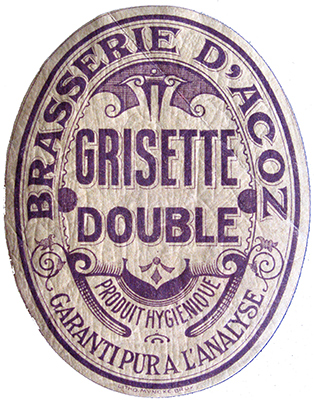
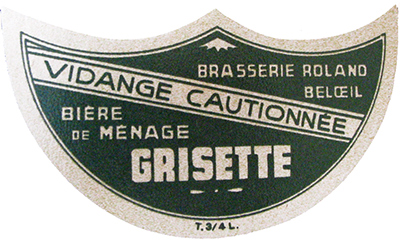
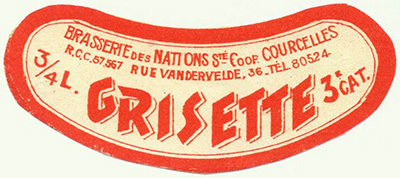
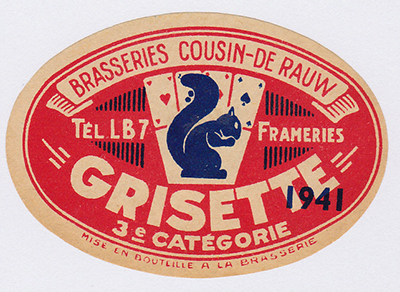
Taking the labels with the above precautions in mind, the old labels for grisette that give a strength indication list 2nd Catégorie or 3rd Catégorie. This category system likely has tax class roots, but it also gives us an idea of the strength range of the beer (see this link from the Netherlands, article 4, also this wikipedia page). According to the modern Dutch categories, a Cat. 2 beer has an OG of 7-11 P (1.028-1.046) and a Cat. 3 beer has an OG of 1-7 P (1.004-1.028).  The specific gravity ranges of such a system have likely changed over time and country to country, but presuming that the categories haven't completely changed, category 2 and category 3 beers would be lower strength than what we would now consider normal strength beer (Cat. 1). Of all the numbered strength categories I saw, there were 3, 2, and 1 corresponding to beers I would expect to be increasing in strength in that order, so that gives us some confidence that the 1900's Belgium system is somewhat similar to the modern Dutch one. If someone knows what specific strength ranges these old Belgian categories meant that would give us a more definite answer, but I suspect it won't be extremely different from the ranges here. There is one label for a beer termed "Grisette double" (see here, note that this brewery closed in 1923, early compared to the other labels here) but mostly when I'm seeing a strength modifier it is 2nd category (see below left), something like table beer/house beer (here as well as Francois and sons above left and Grenier top of the page right) or 3rd category versions (here and here, the same shown below center and right).

Cat. 3 Grisette
Cat. 3 Grisette
Cat. 2 Grisette


Synthesizing this, the bulk of the information seems to be pointing toward a low strength, pale, hoppy wheat beer that would not have been aged especially long, though some versions may have been a bit stronger and aged a bit longer. But it seems that most of the grisettes that we have records of now were lower strength beers. Moving ahead with this, from something in the range of category 2-3, the 3-5% abv sounds about right, with grisettes perhaps more likely falling on the lower end of that range later in their history (category 3 would be on the lower end of that range, or quite easily below it, given the modern Dutch OGs associated with these categories). Unfortunately the labels don't offer any specific recipe info, but we can be reasonably sure that (at least at one point) wheat was a fundamental part of the beers given the info from Brewing with Wheat. Many of the breweries that the labels came from were brewing a number of different beers (saison, pils, bock, brune, abbey beers...) so it seems that in the 1900's at least they were confident working with different yeasts in the same brewery. Along with the general identity of grisette being tied to industrialization, this lends support the grisettes being more of a pure culture fermentation than historic saisons. Because the grisette labels have no indication of being an aged beer, while some other labels of the time do include a note for aged beers (and since it would add cost to a brewery to keep a beer around longer you'd think they would want to advertise it), we can also assume that grisettes were generally served younger. This would mean that the hop character would be more forward than an aged beer of a similar recipe and there would not be much time for bacteria (and in addition wild yeast) development, lending support to the Farmhouse Ales information that grisettes were crisp from hop character and without acidity.

Saison Cavenaile - "matured in out cellars"
This gives us a good ballpark for the sort of beer that a grisette was. I think it is reasonable to think of grisette as a lost branch in the saison family fitting somewhere between historic farmhouse saison and modern saison. Many modern saisons are also more clean (using only Saccharomyces). Modern saison gravities are higher than historic saison, and given the gravity category on saison labels from around the time of grisettes, saison gravities were also higher than those of grisettes. Based on descriptions of "Vieille" or "mûrie dans nos caves" (matured in our cellars) on saison labels, saisons of the time were still beers with more age. With imperfect yeast management this would still allow for the expression of wild yeast and bacteria character, though at the time saisons were also moving toward being pure culture products. In looking at the modern day petite saisons, some of these may have considerable overlap with grisettes. I think a microbially clean (or at least mostly clean) but expressively fermented, shorter-aged, low strength beer with wheat and a more prominent hop profile could definitely be a description of either a grisette or a modern petite saison. To me petite saison is more open to the possibility of lactic acid and/or brettanomyces character, but that may be one of multiple sides of petite saison. So although I don't think the two are interchangeable, I think there are beers out there that could be appropriately described by either term.

A category 1 saison
It would be interesting to get a bit more information on Grisette de Saison as I didn't find anything with that name or mentioning longer aging for grisette in the label collection. That could be something more in line with saisons given the higher gravity and longer aging that Markowski mentions. I'd also like to find out some more info on earlier grisettes. So still some questions remaining. I'll update this post as I find more answers (or if there is enough new stuff then I'll do a follow up post).

Ok, so there's some thoughts on grisette. Here's a recipe for a beer that I was calling a Grisette, at least at the time I brewed it.

Apr 2016 Update: I will be presenting this and continued research on grisette at the 2016 AHA National Homebrewers Conference. Hope to see you there if you are headed to the conference! If not, I am hoping to post a follow with my ongoing research sometimes shortly after the conference.

June 2016 Update: I've started a series of posts expanding on various aspects of grisette based on the research from my NHC presentation. Here are those posts:

Hopping grisette
Categories of Grisette and Grisette Strength
What is Grisette part II

Saturday, September 26, 2015

Barrel Aged Old Ale

It's been an especially long time since I've gotten a post up. Sorry about that. In large part this is due to heading out to the Arctic Ocean on an icebreaker for 6 weeks for my real job. I returned from that trip in late August and had a quick few weeks of turn around before I moved back to Germany for 5 or so months of work. I'm excited about the opportunity to make many interesting brewery visits (Brussels is about a 4 hour train ride form Mainz, where I'm working) but not all that happy about leaving my friends and family in Victoria and leaving brewing for another long stretch. Anyway, that brings me back to the nature of the first posts of this blog - I'll try to keep some retro-active recipe and brewday posts coming but they might be mixed in with more posts about brewery visits and other beer research. On the note of retro-active brewday posts, here's a writeup for a beer I brewed almost a year ago and just bottled before moving to Germany.

After pulling the saison from the 30 gallon wine barrel I share with two other brewers, we wanted to fill the barrel with something that could age longer to finish stripping the oak flavor before we fill it with something along the lines of a Flemish red or something lambic-inspired where we wanted long aging without a lot of wood flavor. For this beer we wanted something that could handle aging for a while to make sure that the next beer could handle a year or more in oak. After an excellent evening of tasting a few old ales with and without brett, we decided on a historically inspired old ale with Brett c. I should note that none of us are British beer historians and we didn't spend a lot of time scouring historic old ale recipes. If that's what you're into then Ron Pattinson's blog and books and Amos Browne's blog (check out the From History tab) are great resources. So the historically-inspired part is pretty loose, and it is mostly just the push for brett and barrel aging.

Racking one of paler beers in.
One of the cool things about sharing a barrel with a couple other brewers is that the beer becomes a blend before the barrel is even able to impart any flavors. Of course we are limited with blending possibilities after the barrel since we don't have a lot of barrels, so blending of different barrel aged characters (both barrel- and microbe-derived) isn't an option. But we do all complete primary fermentation before going into the barrel. And the slightly different directions we go with a loosely agreed upon base result in a beer different from what any one of us would have produced individually. And, at least so far, it has resulted in beers better than any single one of the base beers in my opinion. In this case one of us undershot gravity a bit (if memory serves). With that info delivered to the other two of us, the second to brew adjusted his recipe to accommodate that. For my part, my beer came out a fair bit darker than I was expecting, and darker than I would want in the final product. But I think that balanced well as the other two brews were considerably paler and the blending worked out to make a balanced final beer that was about what we were going for from the start.

The beer at bottling.
To prep for this beer we wanted to knock back the cultures present so far in the barrel (we were getting pretty assertive sour character and we didn't want that here) so burned some sulfur inside the barrel. To burn a homebrew-sized chunk of sulfur stick we cut a piece off of a full stick and fashioned a dish to hold it out of a corked beer cage and some foil. It took a bit of shaping to get it to fit through the bung hole and hold the sulfur chunk well but in the end it worked really nicely. We suspended this with a bit of bailing wire. We didn't worry about keeping the barrel wet as we weren't planning to leave it empty for long. When we were ready to fill we rinsed the barrel thoroughly. And when we felt we had rinsed it enough we conducted some quick tastes of the rinse water to make sure we weren't getting any sulfur carryover.

The old ale went into the barrel in October 2014 and came out June 2015. On many occasions since that planning night I've found myself wondering what I'll do with my 10 gallon share of barrel aged old ale. I'm still not really sure, but at least I'm really happy with how it is tasting at this point. I suppose I'll have old ale around for some time...

Recipe
Brew date: 5-October-2014
Date into barrel: 15-October-2014
Date out of barrel: 28-June-2015
Batch Size: ~15 gallons in carboys
OG: 1.071
IBU: ~53 (Tinseth)

The grist
Grist
Doehnel #28 (Pale English-type malt)  67.9%
Doehnel #24 (Pale English-type malt)  26.2%
Carafa II Special (Weyermann)              3.3%
British Crystal 135-160                          2.7%

Quick note - I think this C 135-160 is a cool addition to darker English oriented beers and have been happy with it whenever I use it.

Hops:
Slovenian Bobek, 5.01% aa. Boiled for 80 minutes for 53 IBU

Yeast:
WLP007 Dry English ale
Brett claussenii (White labs) - added as a slurry from a starter to the barrel.

Other:
1 Tab whirlfloc
1.5 tsp yeast nutrients (Wyeast)
Salt additions to add ~100 ppm each of Ca2+, Cl- and SO42- to what is basically distilled water.

Racking out of the barrel.
When we racked this beer into the barrel we also added a rod of toasted oak from Okanagan Barrel Works (a local winemaker had given me an unused chain of toasted oak meant to be added to neutral barrels to get oak flavor from this now-closed cooper). I don't have an exact mass of that rod but it was about 60-70 g. We rinsed it a couple of times with warm water to mellow the flavor a bit. We wanted to be able to pull this rod out easily so we tied it to the bung with unflavored dental floss.

As I said above, I am really happy with how it tasted coming out of the barrel. I was a bit worried with how oaky it was tasting at ~3 months in the barrel but the harsher wood character mellowed with further aging and it didn't seem too oaky when we pulled it out in June.

I bottled my carboys at the end of August/beginning of September. At bottling I re-yeasted with a bit of RC-212, a non-competitive red wine yeast. The dosing was a bit below 1 million cells per mL as I figured there would still be a bit of brett around. I'll check back in when I'm back in December and hopefully it is conditioning well.

May 2016 update: Here's a quick note on how the beer is progressing from the blog's facebook page. I suppose I should make some full tasting notes soon...

Thursday, June 18, 2015

Seaside Saison Tasting


I always find writing tasting notes on my beers tricky as I often don't have the time/energy to sit down and write out formal notes and when I'm having a beer I am generally giving most of my focus to something else. I'll get a good impression drinking multiple bottles from a batch over time (and to some extent observing the progression can be equally valuable). I'll generally write a line or two to record my overall thoughts, but having a more detailed and critical assessment can be really helpful in building subsequent batches and other recipes. And it is something I'd like to do for every batch. Having this blog helps a bit as it forces me to go through the full review process for recipes that make it up here.

So here is my review for a saison with locally grown and malted barley and a small amount of sea salt added that I am calling Seaside Saison:

Aroma: Great floral/fruit aroma. It is a bit minerally (though this is something that I am looking for in this beer, so that might influence it). There is a Dupont-esque edge in there but this is more earthy. The beer as a nice graininess with some tangy fruit (lime). Overall it is a touch on the sweet side with some toasty grain. It smells tarter than it tastes. Some alcohol seems noticeable in the aroma which surprised me a bit given that the ABV isn't very high.

Appearance: Beautiful fine white head, excellent retention, leaves a chunky lace. The color is a pretty clear gold. I am really happy with the appearance of this beer.

Taste: Over-ripe fruit is forward in the taste (peach, cherry and other stone fruit) along with floral and some citrus (lime comes forward). I like the fruityness here. The beer is mildly tangy, which might be influenced by both acidity and salt. There is some mild but present alcohol. It is subtly but identifiably minerally. I think the salt is at the right level for what I am looking for. The hop presence is pretty low - a bit lower than I'd like and lower than what I expected given the recipe. Perhaps this is influenced by this beer having a much different SO4:Cl balance than my saisons normally do. I'll probably bring the hops up a bit next time. There is some roughness in the finish that I think the salts accentuate a bit. There are some clove-like phenols, which aren't really the type of phenols I am going for.

Mouthfeel: High fine carbonation. This beer has a great mouthfeel - light and fluffy with some creaminess (which I presume is from the flaked grains but it might be helped by the salt as it is more creamy than other recent brews with a similar amount of flaked grain). Dry finish with a fruit skin like character and a light tangyness (probably a combination of salt and acidity).

Overall: This is pretty nice overall and it hit the mark on the general goal very well. The salt amount seems right on (maybe it could be a touch lower but not higher). Now the beer needs some fine tuning. I'll need to take a new run at the fermentation with a different yeast blend (probably back to just using 3724 and 3711). I'm getting a bit more phenolic character here than I want and/or they aren't the right phenols. So dropping the 3726 should help this. And I'll also try to get a bit more crispness and take out some of the roughness. I think the beer needs a bit more hop presence. That should add some crispness. Driving the FG down a bit would also help here and possibly remove some of the perceived sweetness in the balance. I like the graininess and will keep the grist as it is.

I like the OG being in the mid 1.040's, so I'll leave that there. I don't know where the perception of alcohol is coming from. It might be leaving the fermentation warm with these yeasts, or yeast health going in, or pitch rate or something like that. But that is something I'll have to work on. It isn't strong but it is in there and I'd rather it not be. I see a similar sort of alcohol presence in the Dupont beers, but for some reason there it doesn't bother me as much.

So overall success with some room for improvement.

Friday, May 15, 2015

CBC Take Homes

Due to my recent minor involvement with a local brewpub (Moon Under Water) I was able to attend this year's Craft Brewer's Conference. If you don't know about this conference, the Craft Brewers Conference is for professionals in the brewing industry (you have to be a Brewer's Association member so breweries in planning can attend but general homebrewers can't). The conference was in Portland, which was an excellent location for such a thing, and was about a month ago. It was a great experience and I'm very glad to have gone.

I meant to get this up closer to the conference but as these tend to go, I've been delayed. I'm always surprised that it takes me this long to put up posts so I suppose I better either change that or get used to it... Anyway, here are some of my big takeaway from the conference. I'll focus mainly on a couple of presentations, with a bit to say about other presentations, the exhibitors, and the conference in general. Sorry this is relatively heavy on the text and thin on pictures. i guess that's the nature of the post...

Presentations:
The biggest thing I can say about the presentations in general is get in early. Many of the talks, especially those on hotter topics like sour/mixed-fermentation beer tend to fill up. And many people that are interested in the talk end up not being let in. There is time between talks to get to the ones you want to early enough, but it is even better if you can stay in the same room and/or duck out of a previous talk a bit early if it is less informative for you to ensure that you get into the talks you really care about. When the doors opened for the Mixed Fermentation panel there was a steady stream of people entering and it filled really quickly, so if you wanted to show up a couple minutes before it started and still get in you were out of luck.

I'll focus here on two talks - Kara Taylor's Titratable Acidity talk and the Mixed Fermentation panel led by Garrett Crowell of Jester King and including brewers from Sante Adairius, Crooked Stave and New Belgium. Both of these got me thinking and I was especially inspired by the mixed fermentation panel. But there were definitely other excellent talks. Some of the other presentations that stood out for me were a dry hopping talk from Dr. Tom Shellhammer's group at Oregon State. They are at the leading edge of hop research in North America and their talk had some cool information in it. I was most surprised to learn that in some cases oxidized alpha acids may account for the largest portion of bitterness in a beer (between isomerized alpha acids, oxidized alpha acids, and oxidized beta acids). I had heard that oxidized beta acids may have a significant contribution to bitterness, especially when using aged hops in beers following the traditional process of lambic, but had not heard about oxidized alpha acids before. Both oxidized beta and oxidized alpha acids are soluble in beer. And because isomerization does not occur with oxidized alpha acids, they can directly add bitterness without being boiled.

The other presentation I'll mention briefly before jumping into more detail on others was the kettle souring presentation by Ben from Breakside, Ben Love from Gigantic and Sean Burke from Commons. The three brewers described their process and reinforced that they don't believe that kettle souring is a very good technique to make a fully sour beer, and that it should instead be used to add a bit of tartness to an otherwise clean beer. I think that this can't be said enough. I see a lot of breweries and homebrewers getting into quick sours and in my experience these beers are under-attenuated and one dimensional. However, I think it is a great way to add tartness to a beer that is fermented cleanly or to drop the pH a bit before using brett and/or bacteria as I outline in this post. With this said, not all the brewers seemed to follow their own advice as one of the three example beers served was prominantly and one dimensionally sour.


Kara Taylor from White Labs gave a pretty interesting talk about Titratable Acidity. This is something winemakers think about but brewers don't think about it so much. And for the average (or even advanced) homebrewer it may not be especially applicable in everyday brewing. But it may have some really powerful potential when it comes to blending multiple barrels of aged sour beer, especially in a larger commercial setting where testing out the possible combinations becomes a bit more daunting.

In contrast to pH, which measures a combination of the strength and concentration of an acid  by
measuring the amount of the acid that has separated, titratable acidity measures the total acid concentration. For a brief chem overview, you can think of an acid as HA, where the H+ is a hydrogen and the A- is something that this hydrogen is bound to in an exchangeable way. pH measures the H+ part, so the stronger the acid (the more the H+ separates from the A-) and the more of a given acid present, the more free H+ there will be and the lower the pH. Here is a simple diagram similar to one Kara showed where the yellow dots represent the H+ part and the blue dots represent the A- part. Titratable acidity measures the amount of acid, independent of strength, by measuring all of the yellow dots whether they attached to an A- or free. Neither technique is able to fully distinguish one type of acid from others, but equal concentrations of acids of different strengths will have different pH values while having the same titratable acidity.

All that is fine, but what we really care about here is how the beer tastes. In her talk Kara presented that titratable acidity has a better correlation with perceived acidity than pH. In this way, for brewers to target a certain perceived acidity in their beers, titratable acidity might be a better measure than pH. What was even more cool is the possibility of targeting a given perceived acidity from titratable acidity and residual gravity. A higher final gravity or more sweetness in a beer correlated with lower perceived acidity than the titratable acidity would suggest. And with the preliminary data Kara presented, there was potential for a linear relationship between the perceived acidity and the ratio of final gravity divided by the titratable acidity (Plato/TA). A lower Plato/TA value would mean either lower final gravity or higher titratable acidity (or both), and low P/TA beers showed higher perceived acidity. The data set Kara had was very preliminary and was mostly based off of a cluster of low P/TA point and one lone higher P/TA point, so it is hard to tell if there is really a linear relationship. But the idea is pretty cool. And if it is correct then it can be a very powerful asset when blending.

Unlike pH, both titratable acidity and residual gravity will mix linearly. If you mix equal volumes of a 1 plato beer with a TA of 20 with a 2 Plato beer with a TA of 10, you end up with a 1.5 P beer with a TA of 15. In some cases pH may mix logarithmically, but things like different abilities to buffer acidity and the strengths of weak acids will also influence pH, so it may not necessarily mix logarithmically either. For targeting a given perceived acidity in a final product, a brewer blending many barrels can calculate the final gravity (at least before any potential refermentation) and titratable acidity of the blend given the components, and then choose to omit certain barrels or include a desired amount of an acid beer to hit a given P/TA ratio in the final blend. So again, for the homebrewer this may not be as useful as you can more easily taste the combinations you are thinking about, however knowing the titratable acidity and gravity of the beers you have for blending can help give you a starting point for thinking about which beers to try blending together for taste samples. And especially as a larger commercial brewer introducing TA measurements could be really useful tool for blending.


The other presentation I'll focus on here, and the biggest highlight for me in the presentation realm, was a panel discussing Mixed Fermentation led by Garrett Crowell from Jester King and including Chad Yakobson (Crooked Stave), Jason Hansen (Sante Adairius) and Peter Bouckaert (New Belgium, formerly Rodenbach). In this panel, each of the brewers gave a quick rundown of their experience and process and how they adapted what they were doing to use their cultures to produce better results. For the 3 younger brewers/newer breweries, this was mainly about how they formed their house cultures and how they use these cultures in the breweries. All of these brewers were using mixed cultures that can't be reproduced with microbes bought from a yeast supplier. They were mixed cultures maintained in house, with influence from some combination of wild microbes from the environment around the brewery, bottle dregs, commercial cultures, natural drift and brewer manipulation/guiding of that drift. To balance this discussion out, Peter focused on his work with Rodenbach to use lacto in stainless tanks and how they had to adapt their process and let their culture change a bit in order to get the results they wanted.

Some of the brewers also talked a bit about what mixed culture fermentation meant to them. I found this part inspirational and I was really excited to see this mentality to balance out the fast sour methods that seem really popular in North American craft beer today. Not that fast sour beers are inherently bad. I see them as different from mixed fermentation beers and I am not as excited about them because I think many people producing fast sours don't see a difference between these beers and more developed sour beers. When I go for an acidic beer, I almost always do so because I was a complex, well attenuated and drinkable beer. And in my experience fast souring tends to not create this. The beers are frequently unbalanced, not well attenuated, and one dimensional. So while that can produce a fine beer, it doesn't generally produce the developed and complex beers that I am looking for. I think Garrett said it well when he differentiated quick sour beer from mixed culture fermentation "We could make a sour beer very quickly at low temperature, but that kind of deviates from the ambition of mixed culture fermentation in which you have many components that you are trying to represent."

The overarching theme to me in this presentation was that the production of world class mixed fermentation beers takes a different mindset than what brewers are used to for beer production. There is no single set of rules/process/recipes/etc. tat will produce excellent mixed fermentation beer, and this is very different from a lot of other brewing. I've described it a couple times already by comparing mixed fermentation to pilsner. For a pilsner, there is a well established general process and recipe, and following those well and knowing what you are doing will yield a good pilsner. That is not to say that it's easy. Given the number of not excellent pilsners out there it definitely isn't that easy. But with mixed fermentation beer there is no set of steps to follow for success. The brewer must learn his or her culture, his or her process, and how the two relate to each other. And adaptations must be made to guide the culture toward producing the results you want. These brewers came from diverse backgrounds ranging from advanced degrees in brewing to never having worked at a professional brewery before this, and whether the brewer took a more scientific/technical or a more artistic approach to the beers they were making, they had this mindset and followed no technical set of rules. They had an understanding of their culture and how it behaved based on their process. They knew how to increase or decrease acidity, they knew when the beer needed more time, how to maintain their culture and work with or control the natural drift, etc. They knew this from experience with their cultures and careful observation, and they were constantly learning more about how to work with their cultures.

That's not to say there wasn't any information to take out of the talk. All four of the brewers talked about exerting some control over the balance of microbes and the acidity by factors such as IBUs, gravity, temperature  oxygenation, and pressure from larger vessels that can be applied by other brewers. The first one is pretty straightforward - elevated IBUs inhibit bacteria. OG influences production by higher OG (and therefore higher ABV) inhibiting bacteria more than yeast. Depending on the strains you have, temperature can be a bit more complicated. The classical understanding is that elevated temperatures promote lactic acid bacteria. However Garrett at Jester King mentioned that when they ferment cooler, they get faster acid production. This seems counter-intuitive at first, but it makes sense if you consider that they are using multiple saison oriented strains in their culture that like to be at elevated temperatures. And working at lower temperatures may cause those sacch strains to be less active and may leave more for the bacteria. Oxygenation is also a bit more straightforward, with more O2 promoting yeast growth and depending on the specific bacterial strains, maybe inhibiting bacteria. Conversely low oxygenation inhibits yeast growth and leaves more for the bacteria. While both yeast and bacteria don't like increased hydrostatic pressure, Peter mentioned that high pressure seemed to inhibit lacto more than yeast. So there was plenty of technical info in the talk, just no clear set of rules/process/ingredients to follow to get world class mixed fermentation beer. A lot of these aren't necessarily revolutionary (though that Jester King temp experience is contradictory to the classic idea of how the system works) but they show the relatively simple and well grounded thinking that these brewers begin with to manipulate the cultures and process to end up with beers they like. And they show the ability to accept that results may be opposite of norm given their specific set of circumstances.

I'll close out discussion of this talk with two quotes from the talk that sum up to me what the talk was about - learning how to use your own culture to get the results you want rather than following a specific procedure:

It's been a lot of fun not really following any guidelines that have been set out for making beer but learning alongside of the mixed culture. - Garrett Crowell

That's really the biggest thing within our brewery and working with those mixed cultures: how do they work within your process, and how can you work with them and how can you make them work for you. - Chad Yakobson

Exhibitors

There are a huge number of exhibitors at these conferences. I walked around the exhibit all countless times and noticed new stuff every time. And I know I missed some cool stuff as well. Many of the exhibitors are giving away free stuff (yeasts, hops, oak cubes, nutrients, whirlfloc, flavorings, etc. in additional to general non-ingredient swag) so that breweries can try out a bit of the ingredient on a small pilot system. This is especially valuable for homebrewers as our systems are roughly pilot batch sized or smaller. There was quite a buzz at the exhibition about one of the brewhouse manufacturers bringing a coolship. I'll admit, it was impressive and really cool to see that the idea of a coolship is so desirable/mainstream that a manufacturer would bring one rather than a small commercial brewing system (that's probably the best part of it for me). I try not to bring up much negative stuff on here but I think it should be said that cool though that was, the welds looked pretty bad. They were far from sanitary. So my takeaway from that was while manufacturers are interested in getting in to some possibly specialized/less common equipment that brewers of funky/sour/wild beers would want, the execution may not be quite there yet. Or possibly that they are looking to cash in with flashy stuff rather than providing quality/function. But I hope it's the former...

One exhibitor stood out to me as being rather relevant to home brewers in the products they sell as well. This was King Orchards, a company in Michigan producing tart cherry (Both Montmorency and Balaton), pear and apple concentrate. These concentrates are 68-70 brix and are are pure fruit (no other ingredients). Commercial brewers have had access to products like this before with Oregon Fruit (though I'm always happy to see another option on the market). But I think King Orchards is an especially good option for homebrewers as they sell 1 oz packs (the main target audience here seems to be people wanting a single glasses of juice) as well as pints and quarts of concentrate. These small sizes seems perfect for homebrewers playing around with adding cherry to 1 gallon jugs up to normal batch sizes. It might take a bit of work to get the ratios right, but it should be too hard. There might be other comparable products (pure non-frozen juice concentrates) available to you locally, but if not these guys might be worth checking out if you want to try out a small amount of sour cherry in a beer.

The conference in general
Alright, just a bit to close this out on the conference in general. It was a great time. The conference is full of people with an unbelievable amount of knowledge in brewing equipment/process/ingredients/etc. And many of them are there to share that knowledge and pick up what they can from others. I was generally surprised by how friendly and open people were. Especially people like Vinnie (even though he is notoriously open and friendly) who probably get strangers coming up to them dozens to times a day. Sure, there were a bunch of pretty strange questions at talks and some not so informative talks (the biggest disappointment to me was a talk about transitioning from home brewing to pro brewing given by someone who had never homebrewed), but with an open mind and a reasonable amount of desire to look into the odd thing here and there rather than taking everything as pure truth/the best way, there is a lot to be learned.

The conference sat somewhere between a big party (generally not in an irresponsible drinking sort of way but in a having fun and lots of responsible drinking sort of way) and the sort of academic conferences I am used to. CBC is definitely not an inexpensive conference. And personally I might like to see a bit less of the production side of the party (huge trays of not inexpensive food, fire dancers, etc.) and a lowered cost. But maybe that is part of what makes the environment for the rest of the conference what it is. Overall it is hard to put a value on what I got out of the conference. Did I learn my registration price of information from talks? No, I don't think so. But I enjoyed the talks and there were some really inspiring ones (and it is hard to put a dollar value on that). I think the greatest asset was the networking with others in the business. Learning from (or even about) equipment manufacturers, talking with other brewers at the conference, meeting people I look up to in the industry, etc. So it was absolutely worth it. If I was on a tight budget opening a brewery I would probably put that money into equipment rather than heading to the conference again. At least for a year or two. But who knows, maybe if that time comes I'll find myself unable to miss the conference...

Monday, April 13, 2015

Pale Sour Blending

This post details my process for blending together a series of aged sour beers. In 2013 I brewed a good number of turbid mashed sour beers which were fermented with dregs and/or commercial mixed cultures. I had brewed sour/funky beers before these, but these were my first serious directed brews in the direction of what I consider to be the best commercial beers out there. These sorts of beers benefit greatly from blending - taking advantage of the different directions each beer went to create a more complex and balanced final product. My brewing of these beers was aided by moving temporarily to Germany for 8 months, giving plenty of time for these beers to age and fully develop. Leading up to my move I knew that I wouldn't be able to bottle and drink beers that I was brewing but I wanted to keep brewing. So I shifted focus toward long aging beers that I could brew before I left and leave in carboys while I was away. And I have a great friend here in Victoria who was willing to house the carboys (I think about 8 in total) in his basement and check on them to make sure the airlocks didn't go dry. This allowed me to continue brewing before my trip and let me (temporarily) forget that I had these beers aging so I gave them enough time to develop. All together I had 5 sour blond beers between 20 and 27 months old to blend together into final products.

This is a pretty long post, but perhaps that is fitting for beers that took ~2 years to produce and that still have a few months (hopefully not more) until they are ready. I'll present some of my thinking process for production unaltered from my notes. It wasn't a perfect run through but I think it was pretty good for my first go at it and there are things I would do differently next time.


These beers were heavily influenced by Belgian lambics - spontaneously fermented complex acidic beers from the Senne valley of Belgium. Four of the five brews were turbid mashed with a high component of unmalted grain, generally wheat (the fifth brew had ~15% flaked grains). Four of the five had aged hops and were 'coolshipped', or cooled by leaving them open outside overnight. Many brewers, both homebrewers and commercial brewers, apply to term lambic to beers such as these. And there is some debate in the brewing community about whether or not it is fair to use this term. Based on my not calling these beers lambics up to this point, perhaps it is clear that I fall on the 'not using the term lambic for my own beer' side. Many of the best brewers of North American spontaneous beer (De Garde, Russian River, Allagash, etc.) don't apply to term Lambic to their own beer. Some of these brewers are on record saying they choose not to do this out of respect for the Belgian producers whom they hold in high regard. In addition, I more frequently see the term lambic applied to non-spontaneous commercial beers (fermented with pure purchased yeast cultures and blends) when those brewers seem to have less understanding, and possibly less respect, for Belgian lambic. This is certainly not a rule but it is a correlation, and personally I am less likely to buy a North American made beer calling itself a lambic than one calling itself a spontaneously fermented beer. At least in the latter I know what I am getting and it is not fermented with pitched microbes from a lab.

Regardless of which side you are on for the debate on whether the term lambic can be applied to non-Belgian beers, I think my beers discussed here are clearly not lambic for one main reason: they are not spontaneously fermented. I did pitch microbes into these beers. Sometimes it was dregs from commercial sour beers (both spontaneously fermented and pitched) and sometimes it was pure yeast cultures or blends from yeast labs. All of these five beers were open cooled and in some cases I waited an extra day or two to pitch cultures/dregs into the beers, so hopefully I got some contribution from ambient microbes. But whatever the case they are non-spontaneous beers and therefore, whether or not using the term lambic for beers made outside of Belgium is appropriate, these are not lambics.

Alright, sorry that was a bit of a long tangent. It is something that I my thoughts are developing on, especially after beginning friendships with some of the Belgian lambic producers. I get frustrated by seeing breweries around me and across the US and Canada throw the term around to mean sour beer so I feel I ought to make the distinction clear between these beers and lambics.

 The Beers
L to R: Muse #1, Saambic, Sour Saison
For many of these my process was pretty similar. I suppose this is because they were brewed at roughly the same time and I didn't have beers of this sort ready to drink in between these brews so I couldn't really examine my methods with results. Most of the time the unmalted wheat is red wheat and the turbid mash process is the Cantillon-esque one outlined in Wild Brews by Jeff Sparrow. The dregs are generally from cultures I grew rather than straight from the bottle and I proofed the cultures for off aroma (and sometimes flavor if I felt they were fermented enough) before adding them. The biggest thing I'd change about the brew day and microbes would be not using WLP644 (it was new and exciting then), but I'm happy with the results so I suppose it couldn't have been too big of a deal. I was pretty careful to keep O2 out after primary fermentation was done (excepting the oak thing discussed below), so anytime the carboys were opened to add dregs, take samples, or top up after the main fermentation I purged the headspace with CO2.

Muse #1
Muse #1 - Brewed 5-January-2013. 40% local unmalted wheat, 60% 2-row. 0.89 oz/gal (6.66 g/l) aged hops, open cooled, pitched with a bunch of spontaneous beer dregs (2 different 3 Fonteinen geuzes, Tilquin gueuze, Boon Marriage Parfait, Cantillon gueuze and Rose de Gambrinus) and WLP 644. After a couple of months when visible activity was done I swapped the airlock for an oak rod fit inside a stopper. I used white oak, which allows more gas transfer than red oak. This is another thing I'd change (I wouldn't do it at all). This beer got a bit acetic. Not aggressively so but a bit more than my taste preference. That may have been from the white oak (or oak in general), it may have been from this being the oldest beer and I might have fussed with it more, or it might be unrelated to those. Anyway, I think the oak stopper idea isn't necessary or even possibly beneficial (and the general community seems to have moved away from this method as well). I swapped the rod back for an airlock after 6 months. This was topped up after about 6-7 months and transferred to my friend's basement for storage.


Sour Saison
Sour Saison - Brewed 17-February-2013. This is the only non-turbid mashed brew of the bunch. This beer came out of a big brew day with my local homebrewing club BrewVIC. I didn't want to worry about sanitation when I was brewing somewhere else without access to all the things I usually have so I went with a purposely sour beer. The recipe was 65.1% Pils, 14.5% Flaked Triticale, 9.6% Vienna malt, 7.2% Munich malt, 3.6% Acidulated malt. It was hopped with Hallertauer Mittlefrueh and Saaz to 27 IBU with first wort and flame out additions. I open cooled the beer and, along with Wyeast 3724 and WLP644 Trois, I pitched commercial dregs (Brasserie a Vapeur, Upright, and Cantillon). At ~ 5 months it was topped up with unpitched saison wort and a bottle of saison and transferred to my friend's basement.

Saambic
Backyard ambient starter
Saambic - Brewed 30-March-2013. This was my first attempt toward focusing on local terroir, but I did end up pitching microbes into it so actual terroir will have to wait for a future brew (which has already happened but is much to young at this point). It had 40% local unmalted wheat, 60% locally grown and malted barley and 0.45 oz/gal (3.4 g/l) locally grown aged hops. 2 days after brew day I pitched an ambient microbe starter made from leaving wort outside to spontaneously ferment (see this post from the Mad Fermentationist), dregs from Boon Marriage Parfait, 2 different 3 Fonteinen Geuzes, Cantillon Gueuze and a homebrew Russian River Sanctification clone from my friend Dylan. At 4 months it was topped up with unpitched wort from a saison brew and transferred to Mark's basement.

Wild Rye
Front yard ambient starter
Wild Rye - Brewed 28-July-2013. 39.5% local unmalted rye, 60.5% Franco-Belges Pils malt, turbid mashed. 0.5 oz/gal (3.75 g/L) aged hops. This beer was open cooled and pitched with 2 ambient microbe starters and WLP 644 Trois the morning after brewing. About a week and a half later it was transferred from a 6 to a 5 gal carboy and topped up with more from the ambient starters and the trois along with dregs from 2 different 3 Fonteinen geuzes and some ECY01 starter. Two weeks after that it was topped up with ~150 mL of dregs starters from Brasserie a Vapeur, Upright, and Logsdon Cerasus. A week later it was moved to my friends temp stable cool basement and topped up to the neck with ~1.4 L of homebrew saison.


ECY-01
Grain storage room starter
ECY-01 - Brewed 24-August-2013. 39% local unmalted wheat, 2% Acidulated malt, 59% European pils malt, turbid mashed, aged hops (~5.7 g/L, 0.75 oz/gal). This beer was cooled open outside and was pitched with ECY-01, an ambient spontaneous starter, 3 Fonteinen Oude Geuze dregs and a small amount of WLP644 Trois 2 days after brew day. Two weeks later, after primary fermentation was done, it was topped up to the neck with a starter saved from extra wort from this brew along with some more dregs (3 Fonteinen, Cantillon) and more spontaneous starter as well as a bottle of homebrew saison. After this the beer was transported to a basement with exposed rock which stays stable and appropriately cool year round.

Notes from tasting the individual beers
Tasting, and Determining Blends

After gathering all of my carboys back from Mark's excellent care, I took samples of each carboy using a wine theif. I tasted each blend, paying special attention to general level of acidity (and how that compared to what I ideally wanted in a final blend), acetic acid presence, fruity/funky flavor balance, and any other prominent or 'off' flavors. After tasting each sample on it's own and thinking about those aspects, I started working on some blends. (Note- Ha, I just noticed my cross out out of "lambic" in my brewing book. See, these notes really are unedited and are exactly as they appear in my book. For clarity/simplicity sake I am fine using the term lambic to convey an idea amongst others who know how I feel about the use of the term, which is why I had initially written it in my book before quickly crossing it out.)

Notes from different blend trials
In general, as with above, I focused on getting the right acidity (by taste) with sufficiently low to below threshold acetic acid, and also appropriate flavor complexity balancing the fruitier/more citrus-forward beers with funkier/more earthy beers). I kept proportions fairly simple (1/2, 1/3, or 1/4) didn't try to involve more than 3 beers. I either based the blend on one of those two or three or did even splits. I started mostly by working with slightly more complex (three beer) blends and by seeing what proportions of the more acetic beer, which otherwise had nice flavor, were good before the acetic became too prominent. This was valuable but I then moved toward simplifying by focusing on my favorite individual beers and seeing how they complimented each other, and this is likely where I would start next timer After a couple blends working only with the four turbid mashed beers, I remembered that I had this sour saison around that was of similar age and had similar added microbes. Throwing that in the mix helped by providing another good tasting and cleaner beer for blending.


WLP644 beer for lowering acid in the fruit blend.
Once I had determined my favorite blends, I looked at what I wasn't using so much and thought about blends involving those that might be good for fruit (following the lead of lambic production - a lambic blender is not going to put fruit into their best lambics as this would cover up the complexities of the lambic). These less favorite beers weren't bad and they didn't have any big red-flag flaws (strong acetic or ethyl acetate, strong 'mousy' character, etc.) so I figured they would be a good candidate for fruit. Fruit is expensive and adding fruit is not going to remove a strong off character so I would not advise using fruit to cover up flawed beer. It will, however, work nicely with a good but perhaps not as complex/expressive beer since the fruit flavor is going to overwhelm many of the more minor complexities in the base anyway.

I did the blending for tastes by weight by pouring samples into a glass on a scale (0.01 g precision). This allowed me rather precise blend ratios and the ability to try a greater number of different blends but made sample sizes smaller than if I had blended with a graduated cylinder. For just doing this by myself, the weight approach worked out rather well. But if I were to do this with other people I might go with the cylinder approach. If I felt that a blend would be better with the ratios slightly tweaked, I didn't re-blend into my partially consumed taste sample. Doing this would have made determining the ratios very difficult to impossible. Instead I just did a completely new blend.

Planning for full carboy blending - siphon order and volumes
After determining the blends I wanted to do, I thought about the volumes of beer I had and the carboy sizes I had. I wasn't sure when I would be able to bottle and I didn't want to leave a bunch of head space in a half full carboy of a blend that I was waiting to bottle. I made an excel sheet for this based on the blend ratio that I chose and giving larger volume preference to the blends I liked more to fully use the beer I had either in a blend, bottling some plain, or racking some to a new carboy. This part was a bit tricky and it took some playing with to get everything to work out right, but basically I put my starting volumes of each beer at top and then put my blends in, subtracting what I was planning to use for each blend And I adjusted my blend volumes while keeping the ratios so that in the end I used all of each batch and got blends or single-beer transfers of roughly full carboys, with plans to bottle a left over gallon here and there. Once that part was done I re-arranged the blends so that I could rack one full carboy and then move on the next, minimizing siphon transfers. I also tried to minimize how long a carboy receiving a blend was half full. Once I had a racking plan and my blends figured out, all I had to do was wait until I had enough empty carboys of the right size, a good amount of empty bottles, and enough time to do this sort of thing. In early April that all came together and it was time to blend.
The master table for blend ratios, volumes, and siphon order.


Setting up for the blending
Blending day plans/color-coded flow chart
Blending day
As is probably apparent from the notes up until this point, I put a lot of thought into setting this up. I made myself a clear flow chart to follow on blending day. I labeled every carboy with it's blend numebrs and the proportion of each blend going in. The blend ratios were pretty simple so generally I didn't have to worry too much about putting volume markings on the side to tell me how much to transfer. One of the blends was going onto raspberries (8lbs/3.6 kg of frozen raspberries for a 5 gal/19 L carboy) so for this I marked out volumes, taking into account what the raspberries were already taking up.

The other tricky part was going to carbonating the beer, and this was probably one of my most poorly done parts. I had planned to add priming sugar and bottling yeast into bottles by pipet because I didn't want to prime each whole batch as I didn't know what I would be able to bottle that night after the blending. I decided to re-yeast with  RC-212 and, assuming 20 billion cells/g, I calculated how much water I would need to rehydrate that in to yield convenient transfer volumes (I have a 0.5 mL lab pipet) to yield 1 million cells / mL for 375 mL and 750 mL bottles (it ended up being one 5 g yeast pack into ~175 mL for a 0.5 mL yeast spike into 375 mL and 1 mL yeast spike into 750 mL). I rehydrated the yeast in a sanitized mason jar.

It took all my counter space to set this up
That part worked out well, but the priming sugar was a bit trickier. I was also planning on mixing this in a sanitized mason jar by weighing the sugar out and pouring the measured amount of boiling water in to dissolve it. I calculated the same sort of thing, how much sugar for the carbonation I wanted based on the bottle size. And it ended up being a pretty concentrated solution that I needed to produce. Well, I decided to make it a bit less concentrated and just pipet more, but I neglected to account for the volume that the sugar took up and my final volume was about double what my added water volume was. This further increased my necessary priming spike size, which ended up being something like 12*0.5 mL spikes for 375 mL bottles and 24*0.5 mL spikes for 750 mL bottles. This is still an appropriately small volume given my total bottle size and fortunately I wasn't planning on bottling much while doing the racking, but it was a real pain to pipet out. So form this I've learned that the mason jar idea was pretty good and that will work out well next time as long as I have the ability to easily transfer volumes of roughly 10 mL for the sugar.

Setting up for the blending
Once all my bottles and carboys were sanitized, CO2 purged, and pre-labeled it was pretty straightforward and I was able to go through the blending pretty smoothly. I left my bottle filling tip on my hose the whole time, which made it easy to start and stop flows, and I sanitized further up the outside of the siphon hose and handled it with sanitized gloves to avoid getting my hands into the beer. I started my siphon full of sanitizer, using the sanitizer to start flow (as I always do) and ran that sanitizer into an extra bottle (which I later dumped out) until I got to the beer. I racked each beer until I just started to draw air and then swapped the siphon to the next carboy, allowing me to start the siphon for the next beer with the beer in the line from the previous carboy. This was great and I didn't need to re-start any siphons mid-process. I ran that bit of air into a miscellaneous bottle to avoid putting it through the partially full carboys. By the end of the process I had one mystery blend bottle and a full glass of mystery blend from this technique and the siphoning was super easy. The flow was slow enough to allow me to comfortable re-arrange things as I was going, moving full carboys out and the next empty ones in mid-process.

The blending - siphoning beer 1.
It took a lot of setup but all that planning made everything run pretty smoothly. I was able to continue to use the re-hydrated yeast to bottle the future blends (I transferred by weight knowing that I had 100 billion cells in 175 mL and that the weight of yeast was insignificant compared to the water, so there were ~570 million cells/g) and for future blends I was able to re-yeast and prime full carboys, which was much easier.

I think that's about it, though I'm sure I'll remember parts here and there down the road. Overall things went really smoothly and my big takeaways were:

Get a larger transfer pipet to prime each bottle (I still think priming each bottle is a good idea when bottling only one gallon from a 5 or 6 gallon carboy and blending the rest).


The blending - the two carboys that beer 1 was going into
Don't use oak rods/dowels/whatever in stoppers for aging. The beer can be great without it and it probably doesn't help. If it can help, the risk (both ruining the beer or a dangerous pressure build up) is not worth it in my opinion.

Maybe have a second set of hands around next time. Both for the trial blending for a second opinion and for the actual blending. Though overall it worked quite well and, as you can see from the pictures, there wasn't much room left in the kitchen for me, let alone someone else, with all the carboys and bottles in place.


The blending - siphoning beer 2
I think letting these beers go as long as I did was a good idea. Maybe I could have done this a bit earlier and the beers would have been about the same, but I didn't notice any problems/bad flavors from going this long and they are definitely way better than they were at ~7 or so months old (the age of the oldest beers when they went off to Mark's basement). I think if you are really trying to approach lambic-like complexity then patience is key. And heading off for 8 months was a great way for me to let these beers sit long enough to develop some of the complexity I was looking for.

I'll close this out with some extra pictures from my blending and will update as I think of more. Please ask questions about parts of my process if you have them. It may prompt me to remember stuff that I've forgotten and may give me some good ideas for next time.

The raspberry beer - 8 lbs for about 5 gallons
Corking and caging